




Robotic Surgery Tubing Specifications
How to Meet Advanced System Demands
Robotic surgical instruments are hard on tubing in ways that do not always show up clearly in the platform architecture. The geometry is tighter. Bend paths are dynamic rather than fixed. Pressure behavior is less forgiving. Integration tolerances leave less room for the normal drift between a specification and a shipped lot. A tubing spec that would serve a laparoscopic instrument well can underperform in a robotic system, not because anyone missed the basics, but because the system asks more of the tube than the original spec was written to cover.
One of the most common disconnects is not the tube itself, but a specification that describes the tube more precisely than the job it will be asked to do.
That is the gap this guide is meant to address. Not by trying to catalog every tubing parameter, but by focusing on the places where robotic systems tend to ask tougher questions of the tubing than the bench setup did. In that sense, the installed condition becomes the real specification, and the earlier test work is only an approximation of it.
Tolerance and Concentricity
The spec that is right and still incomplete
Tolerance stack-up is one of the clearest examples of how a specification can accurately describe a tube in isolation and still leave room for surprises once the tube is in the system.
A ±0.05 mm bilateral ID tolerance sounds precise. Whether it is depends entirely on the nominal it is applied to. At a 3.0 mm ID, that tolerance represents a 3.3% radius variation, which is manageable for many irrigation applications. At a 0.5 mm ID, common in working channels for endoluminal platforms and aspiration lines in robotic bronchoscopy, the same bilateral tolerance becomes a 10% radius variation. Flow through a circular bore scales with the fourth power of radius. A 10% ID reduction at small bore reduces volumetric flow by roughly 34%. If the flow requirement was set at nominal, the tube is already operating very differently at the low end of its own tolerance band, even though the design itself has not changed.
That is often the point where a team realizes the tube it qualified and the tube being shipped are not functionally identical in the way the application needs.
Wall concentricity adds another layer. Most suppliers report a nominal concentricity figure. Lot-by-lot concentricity is a different number, and the space between the two does not always get much attention when the original specification is written. An extrusion process running at 88% average concentricity may still ship lots at 83%. That thin-wall side becomes a stress concentrator. It is also the side that is most likely to initiate collapse and kinking under bend, which is where tolerance stops being just a dimensional question and starts influencing system performance directly.
The practical response is usually straightforward. For any ID below 1.5 mm, it is worth tightening the bilateral tolerance to ±0.025 mm and verifying it at incoming inspection with a laser micrometer rather than a caliper. At small bore, caliper measurement introduces enough operator variation to become less useful than it appears. It is also worth asking for lot-by-lot concentricity data, not just the nominal specification. The difference between 88% average and 88% worst-case can be the difference between tubing that moves cleanly through design verification and tubing that starts raising questions later in production.
The first bend is a qualification test. The thousandth bend is the design constraint.
Installed Geometry
The bend the spec did not model
Minimum bend radius is one of the most commonly specified numbers in robotic tubing, and one of the easiest to overinterpret. Not because it is wrong, but because it describes a static first bend on a straight specimen, and robotic surgery tubing rarely lives in that world for long.
In robotic systems, minimum bend radius is usually more useful as a design consequence than as a design input. The routing path, derived from actual articulation geometry at real operating angles, should determine the bend radius the tubing needs to survive. When the sequence goes the other way, and the bend-radius spec is set before the routing is fully modeled, the tubing spec can end up carrying assumptions that the final system no longer supports.
This is often the stage where the routing path starts revealing demands the original tubing spec did not fully capture.
Wall collapse and kinking in dynamic paths rarely happen exactly at the stated minimum bend radius. More often they appear just beyond it, at angles the routing encounters during normal articulation but nobody explicitly characterized. A tube specified to a 10 mm minimum bend radius and a routing path that reaches 11 mm under full wrist extension may eventually show its limits at that 11 mm. The spec itself may still look reasonable. The difficulty is that the installed geometry is asking a slightly different question than the one the original test answered.
The first bend is a qualification test. The thousandth bend is the design constraint.
A 10-use instrument articulating 50 times per procedure accumulates 500 full-range bend cycles at the joint. That is the real environment the tubing sees. The useful question is not just whether the line survives one bend to its minimum radius. It is what the line’s ID, wall geometry, and flow performance look like after the five hundredth cycle at body temperature, where elastomers are softer, effective durometer is lower, and kink resistance is reduced relative to the room-temperature bench condition where the original spec was written.
That temperature effect is easy to miss early, especially when first-round bend work happens at 23°C. A line that clears its bend requirement comfortably on the bench may not behave the same way at 37°C in the body. Testing bend performance at temperature is a small step, but it often adds clarity at exactly the point where the design is trying to decide how much margin it really has.
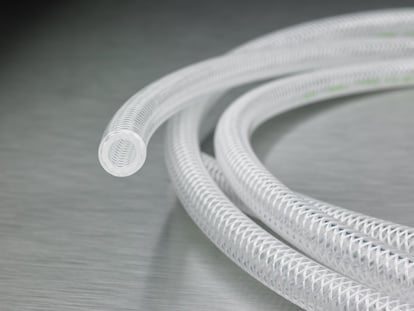
Kink resistance and flexibility remain in real tension. A stiffer tube resists kinking better, but it also carries a higher bend radius. A softer tube routes more easily but buckles under compressive load at tighter radii. The path out of that tradeoff is usually structural rather than purely material. Braided reinforcement changes the equation. A braided silicone tube at Shore 40A can be more kink-resistant than an unreinforced tube at Shore 70A with the same wall thickness because the braid carries the compressive load that would otherwise collapse the wall. For MRI-compatible systems, non-metallic braid such as PET fiber, PEEK fiber, or spiral-wound geometries closes more of that gap than unreinforced construction without introducing a magnetic compatibility issue.
If the application is dynamic, bend-cycle fatigue testing to the actual use cycle count is worth requiring. Weibull failure data is also more useful than mean cycles to failure. In practice, the number that governs the design is usually the B10 life, the cycle count at which 10% of specimens have failed, rather than the average.
Avoiding Common Mismatches in Material Selection for Robotic Surgery Tubing
Most robotic tubing material problems are not simple selection failures in the sense of choosing an obviously wrong polymer. More often they are mismatch problems. A material gets selected for one property and quietly trades away another property the application also needed. The installed condition is usually what makes that tradeoff visible.
- Silicone
Silicone gets chosen for flexibility, and it earns that choice in many robotic applications. At the same time, it can give away pressure fidelity or dimensional stability in ways that only show up under operating conditions. Its gas permeability is real. Under static pneumatic hold, a silicone actuation line will lose pressure through the wall in a way a PTFE or FEP line will not. In applications where tubing cycles against a mechanism or is compressed between components, silicone’s compression-set behavior can also mean the nominal ID does not remain nominal across the instrument’s use life. Those are not reasons to avoid silicone. They are the reasons to ask one more question before using it in a pressure-sensitive or dimensionally critical line.
- Thermoplastic Polyurethane (TPU)
TPU gets chosen for structural integrity, and that is often the right instinct. The point that deserves attention is steam sterilization. Polyester-based TPU grades degrade under repeated autoclave cycles through hydrolysis of the ester linkages. The line can look visually fine while the mechanical properties are already moving. Polyether-based TPU grades offer better hydrolysis resistance, but that usually comes with lower strength and, at softer durometers, tighter process-control demands during extrusion. If repeated steam , the grade decision is best made before the tubing spec is locked.
- Polytetrafluoroethylene (PTFE)
PTFE gets chosen for lubricity and chemical inertness, and both are genuine strengths. The tradeoff tends to show up in dynamic flex and assembly integration. PTFE does not recover from tight-radius bending the way an elastomer does. It takes a permanent set, and in repeated dynamic cycling it will crack at the outer wall sooner than silicone or TPU would. It also cannot be heat-sealed by conventional means, which directly affects fitting integration and assembly strategy. That does not make PTFE the wrong choice. It just means the assembly implications are worth bringing into the conversation early.
- Fluorinated Ethylene Propylene (FEP)
FEP belongs to the same fluoropolymer family but adds optical clarity and melt processability. It shares PTFE’s chemical inertness and low friction, extrudes on conventional equipment, and makes sense where visual confirmation of fluid type or flow matters, or where the tubing needs to stay optically quiet around imaging. Its lubricity is fractionally lower than PTFE’s, but that difference is rarely the governing one. FEP is usually the stronger choice when the application needs PTFE-class chemical and surface performance in a transparent, conventionally extrudable tube.
The broader point across all materials is that many robotic tubing problems are geometry problems or system-integration problems wearing a material label. A silicone line that struggles in a pneumatic actuation application is not automatically the wrong material. It may be the right material in a routing and pressure-hold environment that was never fully designed around its permeability. The best material spec usually comes from understanding which properties the installed condition will actually test, not just which properties look strongest on the datasheet.
Pressure Ratings
A specimen property, not a system guarantee
A supplier’s burst-pressure number is accurate for what it measures: a straight specimen at room temperature with no bending. It is an upper bound on what the tube can handle. It is not a design pressure.
The difference between the catalog number and the real design margin usually comes from four contributors that become more visible in robotic systems.
The first is temperature. Silicone commonly loses 15 to 25% of its room-temperature burst strength at 37°C. A line rated at 200 psi on the datasheet may behave more like a 155-psi line in the body, near tissue, in the actual application. If the design sees thermal exposure, it is worth characterizing burst at use temperature rather than relying only on the default 23°C test condition.
The second is bend state. A tube that bursts at 250 psi straight will fail at a lower pressure when bent to or near its minimum bend radius. The tension-side wall is thinnest and most stressed at the bend, especially if concentricity is not near the top end of the spec. This is especially relevant for pressurized lines routed through a wrist joint or another constrained articulation path. In those cases, the burst number that matters is the installed bend configuration.
The third is the fitting interface. Most pressure failures in assembled systems do not initiate in the middle of the tube. They begin at the fitting, specifically at the transition from constrained geometry inside the barb or fitting body to unconstrained tubing beyond it. That is a stress concentration by geometry, and it is consistent. Assembled burst pressure is lower than tube-specimen burst pressure. Qualifying the tube and qualifying the connection are two different tests, and the distinction tends to become much more visible during design validation if it is not addressed earlier.
The fourth is cyclic pressure fatigue. In pneumatic actuation applications, burst strength is usually not the governing failure mode. Cyclic fatigue is. A tube rated at 60 psi burst can still develop microcracks at the inner wall after thousands of pressure cycles at 20 psi. The failure is gradual and the leak is small, which means it may not show up until late in fatigue testing or extended-use validation. For actuation tubing, fatigue data at operating pressure and actual use cycle count belongs in the design-verification plan from the start.
Sterilization
Where the material decision gets made twice
Sterilization compatibility is often where a material decision made early in a program gets revisited much later, because compatibility is usually checked at the material level and not always re-examined at the component level under real cycle conditions.
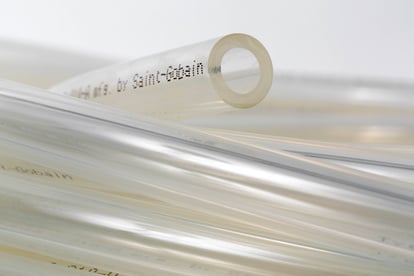
For reusable instruments, the issue is cumulative degradation across the full rated cycle count. Steam autoclave at 134°C causes hydrolytic degradation in polyester-based TPU, progressive softening in lower-durometer silicones, and, more quietly, gradual weakening of the braid-matrix bond in reinforced tubing. That last failure mode can be difficult to spot because the tube may look dimensionally unchanged while the mechanical performance has already shifted. A reinforced line that passes kink resistance and burst at first article may not pass the same tests after 50 autoclave cycles. Validation tends to be most useful when it looks at end of life, not just initial qualification.
For single-use instruments, the dominant constraint is usually the terminal sterilization method, and the sequence in which sterilization method and material selection are decided matters more than it first appears. These decisions are often made on parallel timelines by different functions. When they come together late, a material selected before the sterilization modality was locked may need another look. The simple fix is to lock the sterilization method before finalizing tubing material and geometry. These decisions are closely linked and treating them separately can introduce avoidable redesign work later.
One specific note worth calling out: Polypropylene, which appears frequently in fittings and connectors assembled to tubing, is prone to chain scission under standard gamma-sterilization doses. Tubing that passes gamma compatibility does not automatically carry the fittings with it. If polypropylene components sit in or near the fluid path, they need independent gamma-qualification data.
Why Robotic Surgery Tubing Specifications Must Include System Integration
Every section above describes a requirement that belongs in an engineering requirements document. But the requirement that is often least explicit is the system-level integration spec: how does this tubing perform when installed in the instrument, through its full range of motion, at body temperature, after the rated use cycle count, with the actual fluids it will carry, connected to the actual fittings it will use?
Catalog specs qualify the tube. Integration specs qualify the system. Those are different documents, different tests, and different conversations with the supplier.
A tube can pass incoming inspection and every bench qualification check and still produce an instrument that does not perform. Not because the original spec was careless, but because the spec described the tube more precisely than the job. The installed condition is the real specification. Everything else is an approximation of it.
Writing requirements that reflect that reality, treating the tube as a component in a dynamic, pressurized, sterilized, articulating system rather than as a specimen on a test bench, is what helps a tubing spec hold up not just through design review, but through design validation, manufacturing transfer, and years of clinical use. If you are building a robotic surgical device, bring your tubing supplier into the integration conversation early so the final specification is built around real system demands, not just bench assumptions.

Optimizing sealing and smooth instrument movement in robotic surgery


Discover how injection molding enables precision, durability, and hybrid designs for robotic surgical instruments.