




PTFE Is Not a Specification. The Film Type Is.
Why skived PTFE matters in specialty closures
When PTFE appears in a closure construction, most of the market treats that as the end of the material conversation. The datasheet says PTFE. The supplier points to chemical inertness, broad compatibility, and low extractables. The implication is that once PTFE is specified, performance is largely settled.
In specialty closures, that is often the wrong level of specification.
- What matters is not just that the sample-contact layer is PTFE, but:
- What kind of PTFE it is
- How that PTFE was processed into film
What structural consequences that process leaves behind in the final material.
In chromatography, diagnostics, and other precision sample-handling applications, those details can shape barrier consistency, puncture repeatability, lot-to-lot stability, and ultimately the reliability of the closure in use.
That is where skived PTFE stands apart. Not as a footnote to the material callout, but as a meaningful explanation for why one PTFE-faced septum may behave very differently from another.
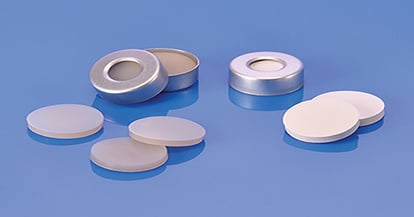
Skived PTFE Septum
PTFE is Not One Thing Once it Becomes Film
PTFE has a strange market problem. Everyone knows the name, so almost no one explains the material.
It is often treated like a universal answer. Need chemical resistance? PTFE. Need inertness? PTFE. Need a sample-contact barrier? PTFE. But once PTFE becomes a usable film, sheet, or composite layer, the relevant story is no longer just polymer chemistry. It is process history.
PTFE can appear as skived film, molded sheet, paste-extruded forms, expanded PTFE, and laminated constructions. These are not interchangeable simply because they share the same fluoropolymer family name. Each carries the fingerprints of how it was formed. Each has different implications for density, porosity, continuity, thickness control, and final behavior.
That matters in closures because the application never sees PTFE in the abstract. It sees one specific PTFE surface, at one specific thickness, inside one specific layered system. That is the level at which performance actually happens.
Why PTFE Processing is Different from Other Polymers
Part of the confusion comes from assuming PTFE behaves like a conventional melt-processable thermoplastic. It does not.
PTFE has an extraordinarily high melt viscosity, which means it does not flow in the simple, familiar way people expect from materials like polyethylene or polypropylene. You do not just melt PTFE and cast a neat film with conventional thermoplastic logic. PTFE products are instead built through routes such as powder consolidation, sintering, paste extrusion, expansion, machining, and conversion from bulk form.
That is not a minor technicality. It is one of the main reasons PTFE form matters so much.
Because the polymer cannot be treated like a standard film resin, the route used to make the final PTFE layer becomes central to the structure it ends up with. Density, void content, microstructure, thickness consistency, and surface quality are all shaped by that route. So, when a supplier says only that a septum uses PTFE, they are naming the polymer family, but not the process history that actually created the useful surface.
Skived PTFE FAQs
Skived PTFE is film that has been precision-cut from a sintered PTFE billet. Instead of being formed as a thin film through another route, it is peeled from a previously consolidated bulk structure, which can support tight gauge control and a highly consistent sample-contact surface.
In septa, the PTFE layer acts as both the sample-contact barrier and the puncture interface. Film consistency affects barrier performance, puncture behavior, reseal performance, and lot-to-lot repeatability. Skived PTFE is often preferred because it can provide a dense, continuous, tightly controlled face layer.
No. PTFE can appear in multiple forms, including skived film, molded sheet, paste-extruded forms, expanded PTFE, and laminated constructions. These forms are created through different processes and are not automatically interchangeable in demanding closure applications.
In a PTFE/elastomer septum, film thickness affects penetration force, stress transfer into the backing layer, puncture channel geometry, and reseal behavior. In other words, thickness is not just a dimensional spec. It is part of the closure’s mechanical design.
The closure is one of the last materials the sample encounters before analysis. Small differences in the sample-contact layer can affect background contribution, reinjection stability, evaporation control, and run-to-run consistency, especially in trace-level methods.
Buyers should ask how the PTFE film is made, whether it is skived from a sintered billet, what thickness tolerances are held, how lot-to-lot consistency is verified, what extractables data exists under use-relevant conditions, and how the full septum construction performs under repeated puncture.
Where Skived PTFE Fits
Skived PTFE film is produced from a sintered billet. That starting point matters.
Rather than trying to create the final film directly through a more conventional film-making approach, skiving begins with a bulk PTFE form whose structure has already been established through compaction and sintering. A precision blade then peels a thin continuous film from that billet. The resulting film can be produced at tight gauges with a high degree of dimensional consistency.
This is why skived PTFE is so important in specialty closures. The film is not simply being shaped. It is being cut from a previously consolidated structure. That gives skived film a different starting point than PTFE forms created through other routes, and that difference can matter in applications where the film has to serve as both the sample-contact barrier and the puncture interface.
Sintered Billets: The Structural Starting Point of Skived PTFE Film
If skiving is the visible process, the sintered billet is the real foundation.
Before film can be skived, PTFE fine powder must be consolidated and sintered into a dense billet. During sintering, the powder particles coalesce into a more continuous mass. This step shapes density, reduces void content, influences crystalline development, and helps determine how uniform the internal structure will be before the film is ever cut.
A high-quality skived film depends on a high-quality billet. If the billet is poorly compacted, inconsistently sintered, or structurally nonuniform, those issues do not disappear downstream. They can show up later as film inconsistency, thickness variation, or less predictable behavior in the finished closure.
That is one reason skiving is such a strong signal of process discipline. It does not hide upstream variation very well. It exposes it.
Why Sample-Contact Surface Matters
The sample does not interact with a material name. It interacts with a real surface.
In a specialty closure, the PTFE face is the actual barrier between the sample and the elastomer beneath it. It is the surface contacted during storage. It is the layer the needle penetrates. It is expected to remain chemically quiet while also participating in a mechanical event every time the septum is punctured.
That means the meaningful question is not simply whether PTFE is chemically inert. The meaningful question is whether this PTFE surface, as manufactured, is consistent enough to behave the same way across the disc, across lots, and across repeated puncture events.
Skived PTFE is valuable because it can provide a dense, continuous, tightly controlled surface well suited to that role. The point is not that skiving changes the underlying chemistry of PTFE. The point is that it is one of the most effective ways to realize PTFE’s inherent advantages in the thin-film form the closure actually uses.
Barrier behavior is really a microstructure story
PTFE is a semicrystalline polymer, and its performance depends in part on how its crystalline and amorphous regions are arranged within the material.
The crystalline regions are more ordered and more densely packed. The amorphous regions are less ordered and offer greater local mobility. When a PTFE film is used as the sample-contact layer in a closure, this microstructure helps shape how consistently the material behaves as a barrier.
That does not mean closure performance can be reduced to one simple crystallinity number. Real analytical behavior is more complex than that. But it does mean that the route used to make the film matters, because the route shapes the structure, and the structure shapes the surface the application actually sees.
A dense, well-consolidated, structurally consistent PTFE film gives the closure a better chance of remaining chemically quiet and functionally stable. In trace-level analytical work, where small differences can become visible in the data, that consistency matters.
Thickness is not just a dimension. It is a mechanical input.
One of the most overlooked aspects of PTFE film in septa is thickness control.
Thickness is often presented like a simple specification line, but in a PTFE/elastomer septum it directly affects puncture mechanics. When a needle enters the closure, the PTFE face resists the initial penetration, the backing elastomer deforms, the puncture channel forms, and the system’s ability to reseal depends on how those events unfold together.
Change the PTFE thickness and you change that mechanical event.
A slightly thicker PTFE layer can alter penetration force, shift how stress is transferred into the backing layer, and change the geometry of the puncture path. A slightly thinner layer can do the same in the opposite direction. These are not abstract differences. They can influence reseal behavior, evaporation control, puncture repeatability, and particulate generation across repeated use.
This is why tight gauge control matters so much. Thickness variation is not just dimensional variation. In a septum, it is mechanical variation.
Where Septum Performance Is Really Decided
A septum fails at the needle site
The most important closure event is highly localized.
A needle penetrates a small region of the septum, often repeatedly and often under controlled automation. That is where consistency matters most. If the face layer varies in thickness, continuity, or puncture response, the system finds it there. If the backing elastomer is being asked to recover from slightly different puncture events each time, that variation accumulates into performance drift.
The failure mode is often subtle. It may not appear as a dramatic leak or obvious split. More often it shows up as slightly changing penetration force, less consistent reseal, incremental evaporation differences, occasional particulate, or analytical variability that is hard to trace back to the closure.
That is why structural continuity in the PTFE face layer matters. The more uniform that layer is, the more likely the needle is to encounter the same surface, the same thickness, and the same resistance every time.
PTFE is not the septum. It is the face layer in a system.
This is where specialty closures become more sophisticated than they first appear.
In many constructions, PTFE is laminated to silicone or another elastomeric backing. The PTFE provides the chemical barrier and sample-contact surface. The elastomer provides elastic recovery, compression response, and much of the reseal performance. The closure geometry, compression state, and lamination strategy all influence how the system behaves in use.
So the right question is never just whether PTFE is chemically resistant enough. The real question is whether this PTFE face layer, at this thickness, laminated to this backing material, performs correctly in the actual puncture and storage conditions of the application.
That is one reason skived PTFE can be so effective in specialty closures. It gives the composite system a more stable top layer to work against. Not just a chemically resistant one, but a mechanically consistent one.
Why This Matters in Chromatography and Automation
Chromatography makes small material differences visible.
The closure is one of the last materials the sample encounters before analysis, which means any inconsistency in the sample-contact layer can show up where users least want it to: in baseline behavior, repeatability, reinjection stability, evaporation control, or unexplained background contribution.
The frustrating part is that closure-driven issues rarely announce themselves clearly. Labs usually look first at solvents, instruments, columns, sample prep, or method parameters. The septum often gets blamed late, even though it sits close enough to the chemistry for small material differences to matter.
Automation makes this even more obvious. A manual puncture event is variable by nature. An autosampler standardizes angle, speed, depth, and force. That means the closure is being tested with much greater discipline. If the PTFE face layer varies from point to point or lot to lot, automation reveals it faster.
Autosamplers do not create septum inconsistency. They expose it.
Why so few suppliers explain skived PTFE
Because it is easier to market PTFE than to explain PTFE.
Once the conversation shifts from polymer name to film type, the buyer can ask harder questions. How was the film made? Was it skived from a sintered billet? How tight is the thickness tolerance across the film and across the finished septum disc? What evidence exists for lot-to-lot consistency? What extractables data is available under relevant storage and solvent conditions? How does the face layer interact with the backing elastomer after repeated puncture?
Those questions move the discussion away from generic material claims and toward actual closure engineering.
That is exactly why they matter.
Questions Smart Buyers Should Ask
If closure performance matters to the method, the buying conversation should go well beyond “PTFE/silicone", ask:
- What form of PTFE is being used and how the film is produced
- Is the PTFE face layer skived from a sintered billet
If not, ask what route is used instead and why it is appropriate for repeated-puncture analytical closure applications.
- What thickness tolerance is actually held across the film and across the finished septum
Not just what nominal thickness appears on the datasheet.
- How is lot-to-lot consistency is verified at the film level
- What backing elastomer is used, how it is cured, and how the laminate is expected to behave under repeated puncture and reseal conditions
- Whether puncture performance has been characterized in a way that reflects actual end use rather than generic material claims
Skived PTFE is a Higher Level of Specification
When a supplier says a septum contains PTFE, they are naming the polymer. When they say it uses skived PTFE, they are beginning to name the structure and process history that explain why the surface behaves the way it does.
That is a more meaningful level of specification.
Skived PTFE matters because it begins with a sintered, consolidated billet whose structure has already been established through controlled processing. It matters because the resulting film can deliver a dense, continuous, tightly controlled sample-contact surface. It matters because tight gauge control translates directly into more predictable puncture mechanics. And it matters because in specialty closures, those differences eventually show up where users feel them most: in repeatability, cleanliness, reseal stability, and confidence in the result.
PTFE is not enough.
For specialty closures, the film type is the specification.

PTFE, Silicone, Butyl, Polypropylene and Emerging Materials


Evolving regulations are shaping material selection and design
