




Why Closure Design is Critical in Medical & Pharmaceutical Packaging
Saint-Gobain Medical does not manufacture closures for soda or beer bottles. But we do support customers in medical diagnostics, pharmaceuticals, laboratory sampling, and specialty chemical applications, where the performance of a closure system is directly tied to the reliability and purity of the product inside.
The ANSES study highlights a broader point that applies across all sectors. It is not enough to trust the materials that make up the container itself. The entire packaging system, including the cap, liner, seal, and any coatings or adhesives, needs to be evaluated. A small design decision, such as the choice of a decorative coating or backing adhesive, can introduce trace-level contaminants that build up or react with the product.
For sensitive applications, especially where sterility, purity, or analytical accuracy is required, the liner system serves as a critical barrier. It controls what enters the container and prevents unwanted material from migrating into the product.
What Makes a Closure System Robust
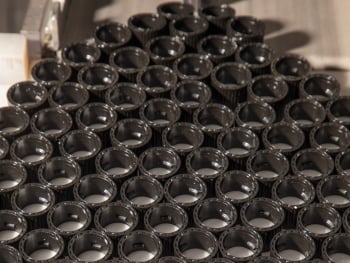
Designing a liner system that performs reliably under these conditions means looking beyond just basic compatibility. Factors such as particle shedding, solvent resistance, sealing force, and mechanical wear all need to be taken into consideration.
At Saint-Gobain Medical, our liner systems are often built using multi-layer structures that combine:
- Inert contact materials to reduce extractables
- Functional barriers for oxygen, moisture, or solvent protection
- Compression layers that support a consistent seal under variable torque
- Reliable backing structures that anchor the liner in the cap
Each element is engineered to support the full use case. Whether the packaging is intended to withstand long-term storage, repeated opening and closing, or exposure to temperature swings, the liner plays a central role in ensuring that what's inside stays stable and clean.
Designing for Cleanliness from the Start
The most important takeaway from the microplastics study is that contamination risks often originate in places that are easy to overlook. In this case, a common packaging component, the painted bottle cap, was introducing particles into products that were otherwise clean. The ANSES microplastics study is a powerful reminder that packaging safety depends on more than just the container: it hinges on the integrity of the entire closure system.
This is the kind of systems-level thinking that drives closure design in regulated markets. It is not just about keeping the container sealed. It is about making sure every part of the closure works in harmony with the product it is meant to protect.
If purity and performance matter, the closure cannot be treated as an afterthought. It needs to be designed from the start, with the liner doing much of the heavy lifting.

PTFE, Silicone, Butyl, Polypropylene and Emerging Materials


Evolving regulations are shaping material selection and design
