





Navigating the Future: PFAS-Free* Tubing Solutions for Medical Devices
As regulatory landscapes shift and restrictions on Per- and PolyFluoroAlkyl Substances (PFAS) grow, the medical device industry faces increasing pressure to identify alternative materials. At Saint-Gobain, we are committed to supporting our customers in navigating these changes by developing and offering PFAS-Free* solutions that align with evolving industry and regulatory standards.
PFAS Regulatory Landscape
PFAS regulations are evolving rapidly across multiple regions. Some states in the U.S., including Maine, California, and Minnesota, have implemented restrictions on the use of PFAS in certain applications. Similarly, Denmark has introduced stringent limitations on PFAS usage, and the European Union is considering an extensive ban under the REACH framework. A restriction proposal submitted by Germany, the Netherlands, Denmark, Norway, and Sweden aims to eliminate the manufacturing, sale, and use of PFAS-containing articles within the EU, including imported goods, over a phased timeline with limited exemptions.
Additionally, the OECD has identified over 4,700 PFAS substances, and some analyses under REACH expand this number beyond 9,000. The complexity of these regulations, combined with the widespread environmental presence of small non-polymeric PFAS molecules, has created significant challenges for the industry. As regulatory pressures mount, medical device manufacturers must proactively seek alternatives to fluoropolymer-based materials to ensure continued compliance and market access.
Understanding PFAS-Free*
PFAS is a broad category of synthetic chemicals characterized by the presence of fully fluorinated methyl or methylene carbon atoms. Due to their unique physicochemical properties, fluoropolymers, a subset of PFAS, have been widely used in medical applications for decades.
Our PFAS-Free* designation is an important distinction: we do not intentionally add PFAS material to our designated products, but we cannot completely eliminate the possibility of trace presence due to environmental factors. Unlike potentially misleading industry claims of absolute PFAS absence, our approach prioritizes transparency and scientific accuracy.
The Challenge of Replacing Fluoropolymers
Fluoropolymers such as PTFE, FEP, and PFA have been the materials of choice for medical tubing due to their:
- Low Friction: Ideal for catheter and guide wire applications.
- Chemical Resistance: Ensuring stability in diverse medical environments.
- Temperature Resistance: Withstanding sterilization and extreme conditions.
Replacing these materials is not straightforward, as no single material offers a perfect one-to-one substitution. Instead, we focus on application-specific alternatives that balance performance, compliance, and sustainability.
Saint-Gobain PFAS-Free* Tubing Solutions
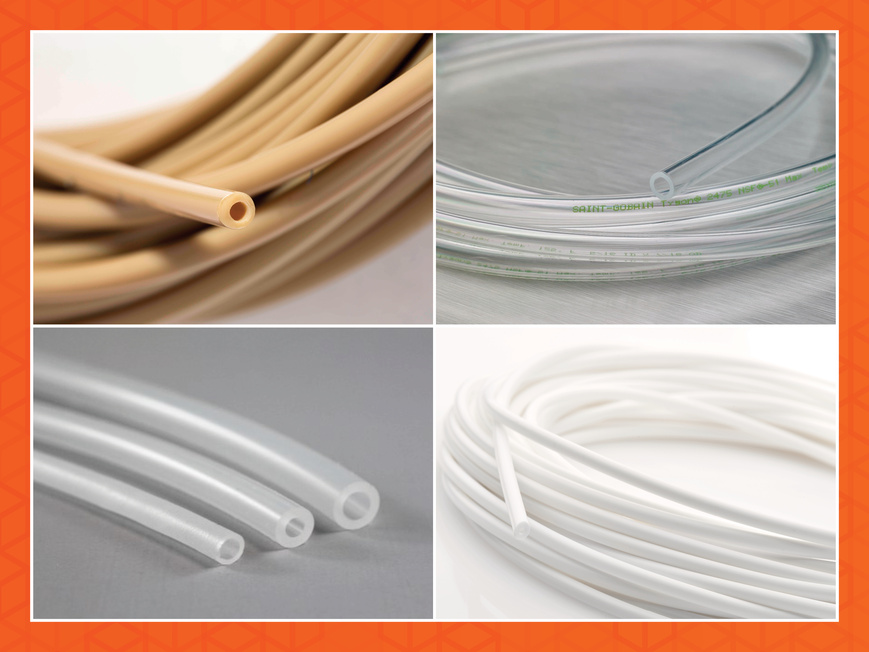
Leveraging decades of material science expertise, we have developed a portfolio of PFAS-Free* medical tubing alternatives designed to address key functional requirements:
- Low Friction: Tygon® LCF
- A thermoplastic elastomer (TPE) with one of the lowest coefficients of friction (COF) in its class.
- A cost-effective, flexible alternative to PTFE-based tubing.
- Chemical Resistance: Tygon 2475
- Engineered for resistance to aggressive cleaners and sanitizers.
- Features a smooth inner surface that minimizes adsorption and particulate entrapment.
- Temperature Resistance: PEEK & Bio-Sil® Silicone Tubing
- PEEK: Offers excellent high-temperature stability and chemical resistance, though it lacks flexibility and transparency.
- Bio-Sil Silicone Tubing: A strong alternative for applications requiring both temperature resistance and optical clarity.
Path to a PFAS-Free* Future
Saint-Gobain remains a leader of material innovation, dedicated to helping the medical device industry transition to more sustainable, PFAS-Free* solutions. Through our robust research, development, and manufacturing capabilities, we continue to expand our offerings, ensuring compliance with current and future regulatory requirements.
We invite you to explore how our PFAS-Free* medical tubing solutions can support your product development and regulatory compliance needs. Contact us today to learn more about our latest innovations in medical tubing technology.

The Critical Role of Material Selection in Medical Tubing


Navigating the world of medical devices in Europe
