



One Size, or Should We Say One Filter Material, Does Not Fit All
Filter Membranes, Media, and Screens in Medical Devices
They say that if all you have is a hammer, then everything looks like a nail. If you’ve ever spec’d a “0.2 micron filter” and moved on, this article’s for you.
In medical devices, filter materials like membranes, nonwoven media, and screens are often lumped together. They all remove stuff, right? But in practice, they behave very differently. Choosing the wrong one can lead to fouling, flow issues, or failed validations. Even worse, the differences don’t always show up until you're scaling or testing.
So, which filter material is right for your medical device application? Let’s unpack it.
Frequently Asked Questions About Filtration Materials
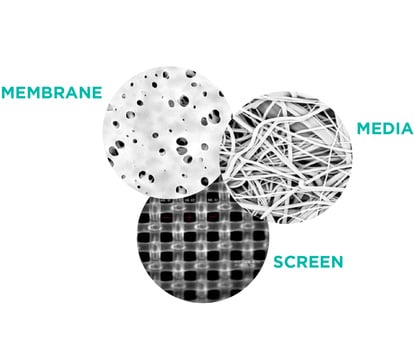
Nonwoven media are mats of tangled fibers created through thermal bonding, chemical treatment, or mechanical entanglement. Their internal openings are irregular, and they can be combined in layers to create thick filter mats, which are ideal for depth filtration. In depth filtration particles don’t just get stuck on the surface; they’re trapped throughout the material.
This layered architecture gives nonwoven media a high dirt holding capacity and excellent flow characteristics, especially when dealing with heavy particulate loads. Materials like polypropylene and glass fiber are common types of nonwoven media, with effective particle filtration offerings ranging from less than 1µm to well over 50µm.
In medical devices you will often see nonwoven filter media upstream of a more precise filter, acting as a buffer that protects sensitive membranes or sensors from clogging. These media show up in applications such as endoscope reprocessors, diagnostic equipment, and other applications where particulate loads can be high and extended service life is critical.
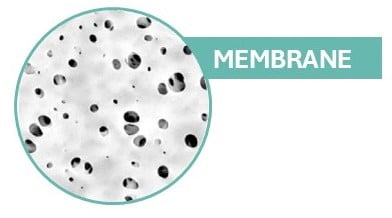
Membranes look and act differently than nonwoven media. They’re cast as thin, film-like sheets with tightly controlled pore structures. The repeatable pore structure creates more predictable filtration behavior than in nonwoven filter media. This gives membranes a high level of consistency and reliability.
Instead of using depth filtration, filter membranes rely on surface filtration. In surface filtration particles are stopped right at the entrance, like a gate. This makes membranes the ideal choice for applications requiring micro and nanofiltration, where particles as fine as 0.2µm and smaller need to be removed. But there’s a tradeoff: surface-only filtration means membranes can have a faster cake build-up under heavy particulate loads, leading to clogging.
You’ll typically find membranes made of materials like PES, PTFE, Polyethylene, and nylon. The benefit here is reliable filtration performance, especially for finer particulate filtration. For this reason, filter membranes are often preferred in final filtration steps, think sterilization of liquids or gas, where certainty and repeatability are key.
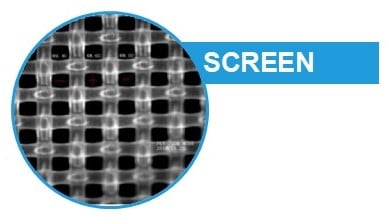
Screens are the less talked-about third act of filtration in medical devices. Made of thermoplastic or metal, screens are woven fabrics made from individual yarns. When woven together, these individual yarns create an extremely strong filter mesh with a predictable opening size.
Like the screens on your window keeping bugs out, what passes through a screen filter is determined by the spacing of the yarns in the screen. If the particle is larger than the spacing of the yarns, the screen filter will keep it out while letting everything smaller through. This means that screen filters offer minimal resistance and extremely high flow rates, along with excellent mechanical strength.
Screens are often used for coarse filtration, structural support, or as a spacer in layered filters. While often associated with larger pore sizes, some screens can filter out particles as small as 5µm.
Micron Ratings: Why the Number Doesn’t Tell the Whole Story
Micron ratings are often treated like hard numbers. Engineers see “0.2 micron” or “5 micron” on a spec sheet and assume they’re comparing apples to apples. They’re not. That number, by itself, doesn’t tell you how a filter performs or whether it will meet the needs of your device.
The problem is that micron ratings mean different things depending on the type of filter material and who the filter manufacturer is. Membranes, nonwoven media, and screens each use different filtration mechanisms and measurement methods. Even if they’re labeled with the same micron size, they behave differently in practice.
With membranes, the rating refers to a highly controlled surface pore structure. These filters are often tested with challenge particles or microorganisms to verify retention performance, using defined standards like bacterial log reduction or bead retention curves. When a membrane is labeled 0.2 microns, that is often an absolute rating, and the pore size reflects predictable and repeatable retention (usually 99.9%) of particles at or above that size. It’s a performance claim, not just a physical measurement.
Nonwoven media are a different story. These materials are made of tangled, randomly oriented fibers. The pore structure isn’t consistent across the sheet, and particle capture happens throughout the depth, not just on the surface. When a nonwoven filter is labeled as having a 5-micron pore size, that’s a nominal micron rating and not an absolute rating. A nominally rated filter means it might retain anywhere from 50 to 90 percent of particles in that size range, depending on flow rate, particle shape, and other conditions. It’s a useful approximation for system-level design, but it’s not a guarantee that all particles at or above that size will be filtered out.
Screens are the most straightforward of the three filter material types. A screen’s micron rating is based on mesh geometry. If the spacing between the fibers is 100 microns, that’s the size of particle it can physically block. There’s no depth to the material, no variability in path, and no additional challenge testing involved. What you see is what you get. But unlike membranes or media, screens won’t capture anything smaller than their openings, and they offer no real filtration below that threshold.
So, let’s say you’re comparing three filters that all claim ratings of “5 microns.” Here’s what that might look like:
- A 5-micron membrane will block virtually all particles of that size, and maybe some even finer. However, it may clog quickly under high particle load.
- A 5-micron nonwoven media will allow some 5-micron particles to pass, while continuing to flow even as the filter loads up with particles.
- A 5-micron screen will block only particles larger than the mesh openings and let everything else through.
This is why the micron rating alone is not enough. What matters is the type of filter, how the rating was determined, and whether the filter can meet your performance goals under real-world operating conditions.
If you’re designing a system that needs precise retention, like removing bacteria from an air or liquid stream, then a membrane with a verified retention profile is the right choice.
If your goal is to keep debris from clogging a downstream sterilizing grade filter or sensor, a nonwoven might be better suited.
And if you just need to keep large particles out while maintaining normal flow, a simple screen may do the job.
The bottom line: a micron rating is not a universal truth. It’s a shorthand, and it only has meaning when you understand what kind of filter you’re working with.
Membranes, Media, and Screens Performance Comparison
| Feature | 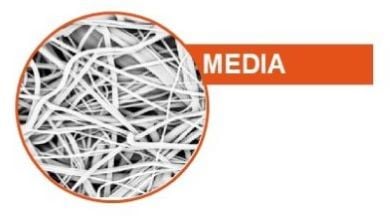
| 
| 
|
|---|---|---|---|
| Flow Rate | High | Moderate | Very High |
| Retention Efficiency | Moderate | High | High |
| Dirt Holding Capacity (DHC) | High | Low | Low |
| Cost | Relatively Low | Higher | Moderate to High |
| Best Use | Prefiltration, high-load applications | Final filtration, sterile applications | Coarse Filter or Support |
When to Use Each Media Type
Material Uses
Use Nonwoven Media If:
- You need to protect downstream membranes or components
- High particulate load is expected
Use Membrane If:
- Sterile or final filtration is required
- Regulatory standards demand high retention
- You need consistent, validated performance
Use Screens If:
- You need to keep out visible debris without choking flow
- You’re building a cartridge or assembly and need structural reinforcement
Designing with the Application In-Mind
Filtration in medical devices is not just about picking the best material. It is about selecting the right combination of filter types that match your device’s flow path, function, and performance requirements.
The most effective filters do more than remove particles. They help manage pressure drop, protect sensitive components, maintain consistent performance over time, all while meeting the regulatory requirements of your application. Membranes, nonwoven media, and screens each play a specific role. When used together in the right configuration, they form a system that is more reliable and efficient than any single element on its own.
If you are designing a new device or troubleshooting a filter that is not meeting expectations, take a closer look at how your filtration is structured. The strongest systems are not built around one type of filter. They are built around how different filters work together in a specific application.
If you need help thinking through the best approach for your application, we are here to support you. Let’s build something that works the way it should: from concept to clinical use.

Understanding the key differences in filtration material selection


Surface area for optimal flow & filtration efficiency
