





EFA Essentials: Surface Area for Optimal Flow and Filtration Efficiency
In the world of filtration, precision is critical. One key parameter that can make or break the success of your filter application is the effective filtration area (EFA). Determining the appropriate EFA for your device or application is crucial because it affects the filter's overall performance, including efficiency, flow rate, service life, and pressure drop.
The experts at Saint-Gobain Medical have created the following guide to help you understand, calculate, and optimize EFA for your needs.
What Is Effective Filtration Area (EFA)?
EFA refers to the total surface area of filter media exposed to the flow of liquid or air; it’s where the actual filtration occurs. The effective filtration area is different from the overall filter area, which includes portions of the filter media that do not contribute to filtration (e.g., areas covered by adhesives, melt flow, or structural elements). When you are researching filters, be sure to take note of which type of filtration area metric is being reported.
Depending on where you live, or the industry in which you work, you might see EFA expressed as square centimeters/meters (cm2, m2) or square inches/feet (in2, ft2).
There are three main factors that impact EFA:
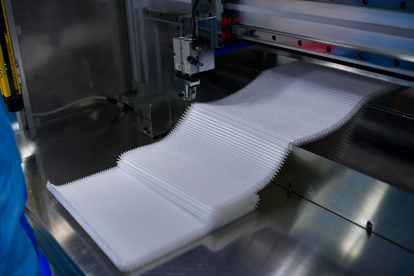
- Pleat design. Filters with more pleats have a larger EFA due to increased surface area. When compared to flat-sheet filters, pleated filters can be used to increase EFA while maintaining a compact form. However, pleats can become clogged with particulates, thereby reducing the usable area over time. So, it’s not about maximizing pleats, but rather about optimizing the pleat configuration to suit the performance needs of the application.
- Filter media. Different filter media types can have significantly different effective filtration areas due to their structural and functional differences. When comparing the EFA of a membrane and a non-woven, both with a pore size rating of 0.2 um, the membrane will have a slightly lower EFA as only the surface contributes to filtration.
- Filter size. Generally, a larger EFA supports better throughput, lower resistance, and longer service life. However, larger filters also tend to be more expensive. It’s important to balance size, EFA, and cost when selecting a filter.
A well-calculated EFA ensures the filter can handle the required flow rates, maintain efficiency, meet service life targets, and avoid unnecessary pressure drops, all while supporting a cost-effective system.
How to Calculate EFA
There are different formulas to calculate the required effective filtration area (EFA) for liquid vs. air applications because the mechanisms and dynamics of filtration differ significantly between these two mediums. Liquids tend to be more dense and more viscous than gases, which impacts how particles move through and interact with the filter media.
Calculating EFA for Liquid Filter Applications
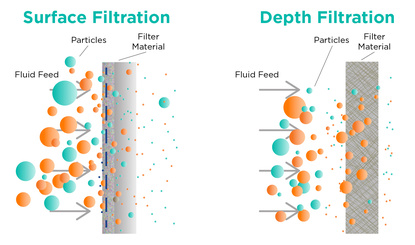
In dead-end liquid filtration, surface filters function like a sieve in that they trap particles on the upstream surface/layer, making them ideal for applications that require precise filtration (Figure 1a). Membranes, such as polyethersulfone (PES) and polytetrafluoroethylene (PTFE), act as surface filters; this is also true for screen materials, such as polyester. Depth filters, by contrast, capture particles throughout their thickness and provide relatively higher dirt-holding capacity, making them well-suited for pre-filtration and for fluids with high particulate loads (Figure 1b). Media, such as glass fiber and polypropylene (PP), function as depth filters. Explore the Saint-Gobain filter material library for a more detailed review.
The concept of effective filtration area varies for surface vs. depth filters. For surface filters, the EFA is represented by the exposed surface area of the filter material; for depth filters, it’s a more complex concept influenced by media thickness and internal structure.
To calculate the EFA for a specific application, start by determining the required volume of liquid your filter needs to process over time. If you have already identified the appropriate filter media for your application, the next step is to assess the filtration capacity and water permeability of that material. Filtration capacity is usually measured in liters per square meter (L/m2); water permeability is expressed as liters per square meter per hour divided by pound per square inch gauge (LMH/psig). A scaled-down model of your filtration system can be used to determine the expected filtration capacity.
It's important to consider factors such as flow rate, viscosity, and variations of the solution being filtered. For example, a more viscous fluid would likely warrant a filter with more surface area to achieve certain flow rate, pressure drop, and throughput targets when compared to a fluid with lower viscosity.
Once you have established the filter capacity and water permeability, the formula below can be used to determine the effective filtration area.
Formula (Liquid Filters):

Ensure the units align to avoid miscalculations. Water permeability is often expressed as LMH/psig; to convert this to LMH/bar, you can multiply water permeability x 14.7 (as shown in the formula above), since 1 bar is approximately 14.7 psi. Also, be sure to adjust for unique application parameters such as viscosity or contamination levels.
Calculating EFA for Air Filter Applications
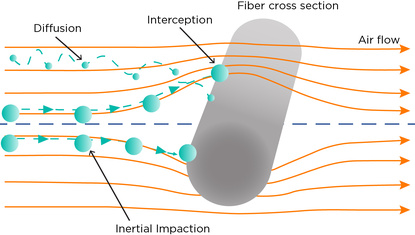
In air filtration applications, particle capture relies on several physical mechanisms to remove contaminants from the air stream (Figure 2). These mechanisms include, but are not necessarily limited to:
- Diffusion: Captures ultrafine particles that move randomly via Brownian motion and eventually stick to fibers.
- Interception: Traps mid-size particles that follow airflow streamlines (orange lines, Figure 2) and come into contact with fibers.
- Inertial impaction: Retains larger particles that deviate from airflow streamlines and collide with filter fibers.
HEPA and ULPA rated filters use a combination of these mechanisms to capture particles ranging from coarse dust to submicron pathogens. Filtration efficiency depends on particle size, airflow rate, and filter media design. An optimized air filter will be engineered to balance filtration performance and pressure drop.
Calculating EFA for air filtration applications includes more complex variables as compared to liquid filtration. While calculation is possible, it is built upon prior testing data and engineering expertise.
A simplified approach for calculating the required surface area entails dividing the system’s air flow rate (measured in cubic feet per minute, CFM) by the recommended face velocity across the filter material (measured in feet per minute, FPM).
Formula (Air Filters)

This formula works well for initial sizing and concept validation.
Other considerations include:
- Gas flow rate variability
- Pressure drop limits
- Particulate/contaminant type and size
- Flow dynamics (laminar vs turbulent)
- Filter geometry
- Pleat design
While the simplified EFA formula offers a reliable starting point, engineering an optimized air filter requires careful attention to system-specific variables and performance goals.
Pro Tip: Always Include Safety Margins
Real-world conditions can vary significantly from the ideal conditions assumed during the development process. Particle load, flow rates, and pressure drops can vary between a lab/development setting and a hospital/field-based setting. Applying a safety factor to your filter EFA can:
- Account for variation between development and end-use conditions.
- Provide a performance buffer for unforeseen issues such as increased contaminant load or fluctuations in operational demand.
- Mitigate performance degradation over time.
Incorporating an appropriate safety factor into the filter EFA can help to maintain the desired performance, even under challenging circumstances.
Why EFA Matters
EFA is more than a number, it’s a critical factor to ensure:
- Optimal System Performance. Selecting a filter with the appropriate EFA:
- Mitigates the risk of increased pressure drops, which can strain the system by requiring more energy to maintain the desired flow rate;
- Ensures maximum filtration performance, which minimizes the risk of particle bypass and preserves system integrity; and,
- Avoids pre-mature clogging which can significantly reduce the filter’s intended lifetime.
- Cost-Effectiveness. Underestimating EFA can lead to overburdened filters, frequent replacements, and increased maintenance costs, while oversizing can inflate costs unnecessarily.
Calculating the appropriate EFA for your device or application is not just a technical step, it’s a cornerstone of successful filtration system design. By taking the time to assess your application’s needs, consulting with professionals, and factoring in safety margins, you can achieve efficient, reliable filtration performance. Let's get started!


Why a custom filter may be the optimal choice for your medical device


A practical guide to selecting filter media based on application, fluid compatibility, flow performance, and filtration efficiency.
