




Developing Custom Filters for Medical Devices
Getting Started with Custom Filter Development for Medical Devices
In medical device engineering, filter longevity and effectiveness are crucial for consistent performance. While there are many standard filters available, they often fall short in medical settings where precise flow rates, reliability, and compact size are essential. Custom filters can better meet the needs of critical care devices, diagnostic equipment, IVF incubators, and endoscope reprocessors. Designing custom filters is a blend of science, engineering, and creativity. We’re here to guide you through the process. This blog will outline how custom filtration systems can address the limitations of standard filters.
Understanding the Need for Custom Filters
Custom filtration solutions can enhance system efficiency, reduce costs, optimize filter lifetime, simplify filter change outs, and prevent incorrect filter installation.
You might be asking yourself: What does customization MEAN in the context of filter design? In the table below, we’ll give a couple examples of standard vs. custom for various aspects of a filter, along with an explanation of how using a customized option can benefit your device.
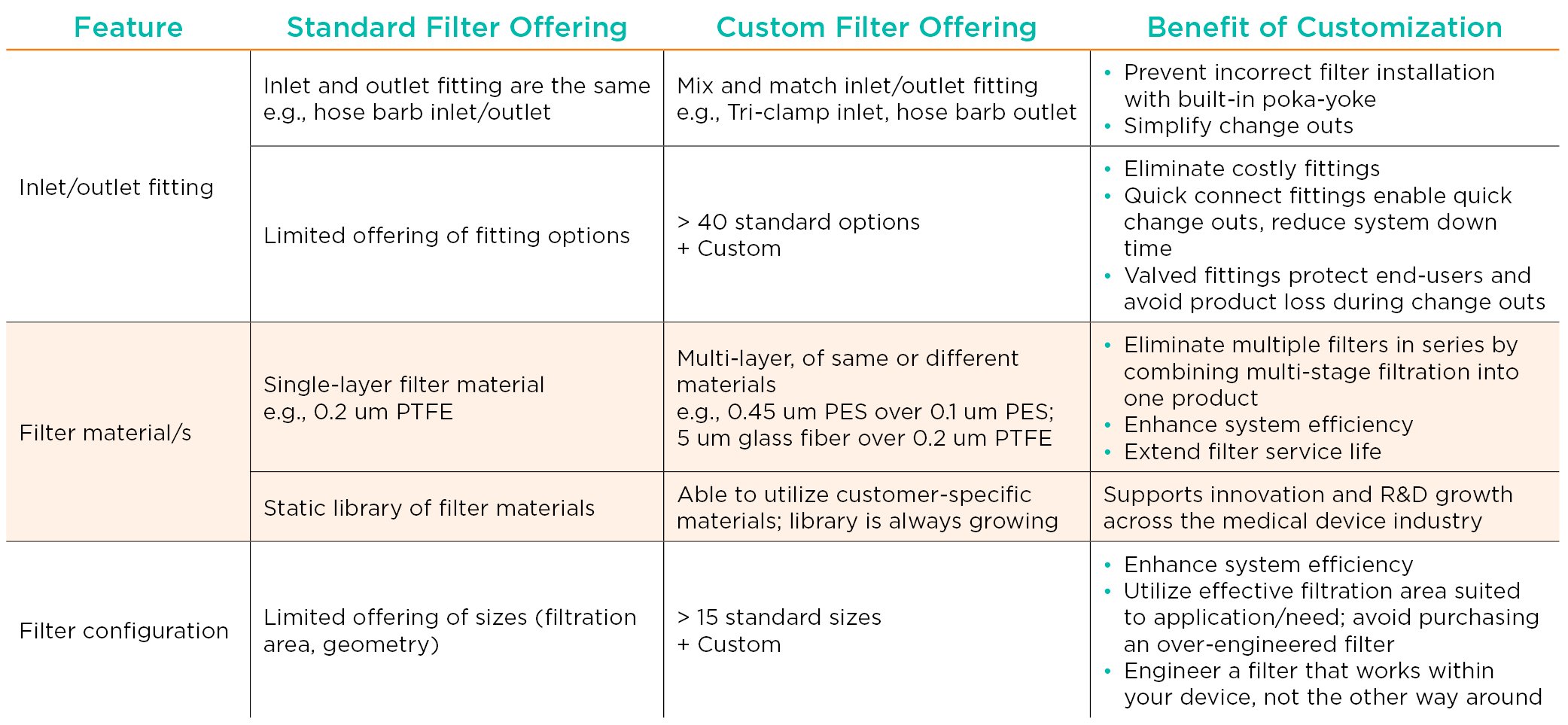
Customization can also address design challenges such as miniaturization and unique geometries. Now that you have a better understanding of what a custom filter is and the value it can bring, let’s discuss how to get started with the design process.
The Foundation: Defining the Filter’s Purpose
Start by defining the filter's purpose and the operating conditions. The filter’s purpose includes the functionality, the feed (what’s being filtered), and any regulatory requirements the filter must meet. The operating conditions include the temperature, the pressure and flow rates, and the sterilization requirements.
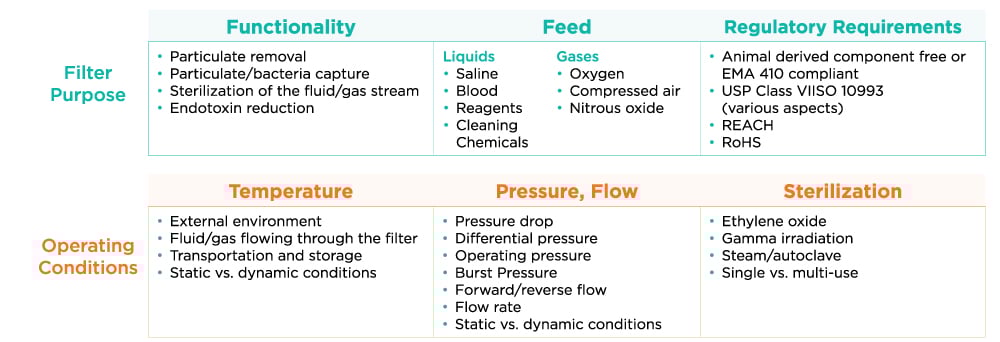
For applications with moderate functional requirements and operating conditions, off-the-shelf filters may provide sufficient functionality. However, when a filter needs to withstand specific and/or heightened demands for pressure drop, flow rate, operating pressure, and/or cycles of operation, a custom filter might be your best option.
Once you have the foundation in place, our experts can guide you through your options for filter material/s, configuration, connectivity (inlet/outlet fittings), and performance testing.
Select the optimal filter material for your application
Filtration materials can be categorized according to the type (media, membrane, screen), the effective pore size or micron rating, the pore distribution (symmetric vs. asymmetric), and the affinity for water (hydrophilic vs. hydrophobic). As you hone in on the right material for your application, it will be essential to re-visit the filtration requirements outlined above, specifically:
- What is the filter’s purpose? Particulate removal, pre-filtration, sterilization, multi-stage?
- What type of fluid or gas will be filtered?
- What are the regulatory requirements of the filter?

The answer to each of these questions will influence the material selection for your device.
For most medical device applications, hydrophilic material will be best-suited for liquid filtration and hydrophobic material will be best-suited for gas/venting applications.
Depending on the performance requirements of your application, you may need to consider a multi-layer filter. The engineering team at Saint-Gobain can optimize layering of filter materials to achieve three main goals:
- Filter Lifetime (e.g., extended or optimized to a particular timepoint)
- Multi-stage Filtration
- Multi-functional Filtration
When selecting the filter material that is best suited for your application, there are many facets to consider. It is important to collaborate with an engineering team that provides an in-depth understanding of both material properties and application-specific requirements.
The filtration experts at Saint-Gobain can help you determine which material (or materials) are right for your application.

Configuration - Form Factors
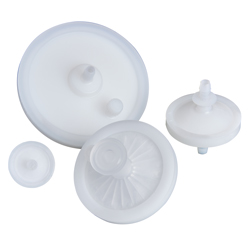
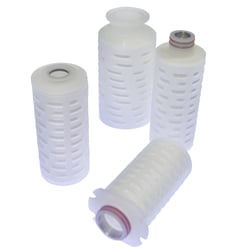
There are three main types of filter configurations: discs, cartridges, and capsules. When determining which configuration is best suited for your device/application, you’ll want to consider the effective filtration area (EFA) and the size/shape.
- The EFA represents the total area of filter material exposed to the flow of liquid or air; EFA is a critical parameter because it can impact flow rate, dirt-holding capacity / service life, and filtration process efficiency. Your selection of filter material/s can impact the EFA required for your application.
- The size and shape of the filter determine how it’s going to fit into your device. The way a filter fits into your device can impact human factors and usability for both standard operation and preventative maintenance.
After you determine an appropriate EFA, selecting the filter configuration becomes easier.
| |||
Diameter | 0.47” – 3.90” | 1.14” – 2.76” | 1.6” – 3.5” (41 mm – 90 mm) |
Length | 0.17” – 0.39” 4.4 mm – 10 mm | 1.5” – 40” | 1.6” – 11” (41 mm – 0.28 m) |
EFA | 0.005 in2 – 9.3 in2 | 23 in2 – 5.9 ft2 | 23 in2 – 5.9 ft2 |
* Product dimensions are approximate and can vary depending on the configuration and/or fittings. EFA can vary with material and pore size. * Full-size (10”) Cartridges can be combined to form filters up to 40” (1 m) in length. Full-size Capsules (10” ZenCap® filters) can also be combined into groups of up to 4 filters. | |||
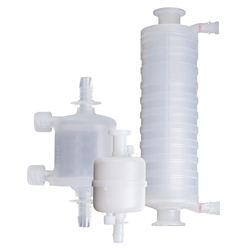
Once you know the filter configuration, the next step is determining the appropriate inlet/outlet fittings.
Reliable connections, seamless integration
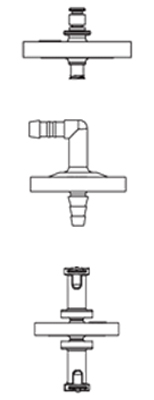
Prioritize the reliability of connections, and the ease of installation, with the unparalleled selection of inlet/outlet fittings offered by Saint-Gobain. Our fittings can be grouped into categories of hose barb, luer, threaded, quick connects, push to connect, tri-clamp… and, of course, customer-specific custom fittings.
There are several potential advantages associated with incorporating customized fittings at the inlet/outlet of your filter:
 |
|
With over 40 standard options available, and the ability to customize, you should have no problem selecting the inlet/outlet fittings best suited for your application.
Once you have the configuration and the inlet/outlet fittings, the next step is to define the filtration material/s.
Performance testing informs product design
Performance testing generates quantitative data which can be used to help you select the right filter material/material combination and the optimal EFA required to meet or exceed your specific performance endpoints for flow rate, throughput, and service life.
Tests to consider:
Particle Retention: Measure how well the filter captures particles.
- Flow Testing: Assess flow rates and pressure drop.
- Biocompatibility Characteristics: Assess characteristics of filter as part of finished device risk assessment.
- Chemical Resistance: Test against relevant substances.
- Filterability Trials: Use a small amount of your product to generate quantitative data.
Saint-Gobain understands that performance testing and biocompatibility characteristics are unique to each application. We will work with you to build out the appropriate test plan for your application.
Customized, never compromised
Rather than settling for what’s available off the shelf, collaborate with Saint-Gobain to adopt a holistic approach to filter design that combines customization, strategic consultation, and the integration of cutting-edge technology. By incorporating the right design features from the start of your project, you can unlock the full potential of your filters. Customized features needn’t add to the overall cost of your filter and can minimize the impact of downtime and equipment servicing in the long run. You can rely on our engineering expertise to guide you through the process.

A practical guide to selecting filter media based on application, fluid compatibility, flow performance, and filtration efficiency.


Filtration Nonwoven Media, Membranes, and Screens in Medical Device Applications
