



Tygon® ND 100-55 Tubing: Setting a New Standard for Clear Tubing Spallation Resistance
In a peristaltic pump, every rotation is an act of controlled deformation. The tubing compresses, rebounds, and repeats, often millions of times over its life. With each cycle comes the potential for microscopic surface wear known as spallation. Those invisible particles may seem inconsequential, yet in medical and diagnostic systems they can quietly degrade performance by clouding optical readings, clogging filters, and triggering premature service calls.
For years, the conversation around tubing selection has focused on lifetime, flow stability, and chemical resistance. As analytical systems become more sensitive, cleanliness under mechanical stress is proving equally important. Among clear tubing materials tested under identical conditions, Tygon® ND 100-55 demonstrated the lowest measurable spallation, approximately tenfold lower particle generation than comparable clear tubing formulations.
This difference is not theoretical. It is the result of material engineering that resists abrasion, maintains surface integrity, and keeps the fluid path as clean on the thousandth pump cycle as it was on the first.
The Overlooked Mechanism Behind System Drift
Spallation occurs when a tubing’s inner wall sheds microscopic fragments under repeated compression from pump rollers. Over time, the same contact area endures millions of cycles, generating small particulates that accumulate in filters or settle in flow cells.
In medical irrigation, these particles can enter the sterile field or alter fluid clarity. In diagnostic analyzers, they can distort optical baselines, foul ion-selective electrodes, or shorten the life of downstream filters. What makes spallation challenging is that it develops gradually and often goes unnoticed until contamination forces a maintenance event or unexplained measurement drift appears.
The phenomenon is mechanical at its core. Each occlusion introduces local strain, heat, and shear that can fracture the tubing wall at the microscale. Factors such as filler–matrix adhesion, additive migration, and wall finish all influence how quickly those micro-fractures evolve into loose particles.
Why It Matters More Than Ever
In the past, many systems tolerated a degree of particulate generation. Early diagnostic instruments used wide flow paths and low-sensitivity optics, allowing small debris to pass unnoticed. Today’s instruments are different. Analyzer fluidics now include orifices measured in hundreds of microns and sensors tuned to detect trace reactions. That evolution has made tubing cleanliness a controlling variable in overall system stability.
Even small differences in spallation rate can have measurable consequences. A tubing that generates 5,000 fewer particles per milliliter over a 24-hour test window can translate to tens of thousands fewer particulates circulating through a closed loop. Those particles, if left unchecked, can reduce filter life, increase downtime, and add to service costs that accumulate over thousands of installed instruments.
International standards such as ISO 19727:2017 provide a framework for evaluating particle generation in peristaltic pump tubing, but their parameters are oriented toward dialysis systems rather than IVD analyzers. The Saint-Gobain research team adapted the framework to better represent diagnostic duty cycles with smaller-bore tubing, lower flow rates, longer service durations, and tighter particle detection thresholds.
Testing Designed for Real-World Conditions
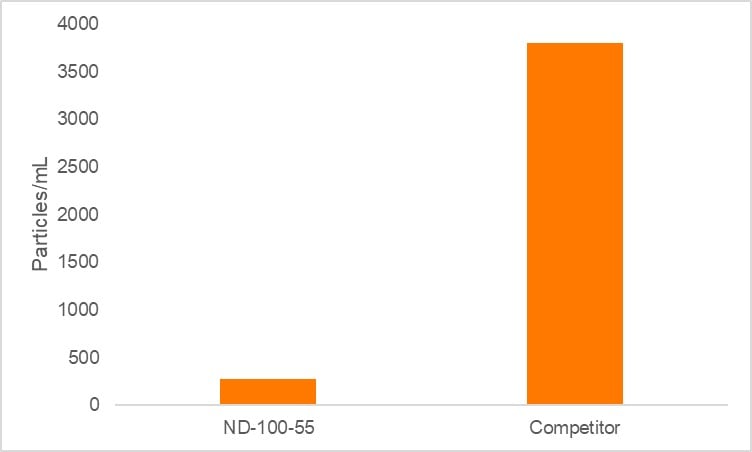
In the modified study, tubing samples were tested using a Watson-Marlow peristaltic head operating continuously at 32 rpm over a 24-hour period. The test circuit was closed and recirculated 50 mL of ultrapure DI water to eliminate environmental contamination. After the run, particle counts were measured by imaging flow cytometry with a 0.2 µm detection threshold, providing greater sensitivity than standard ISO methods.
Under these conditions, Tygon ND 100-55 achieved a median particle count of 458 particles per milliliter (Figure 1), while competing clear tubing formulations recorded counts roughly ten times higher. The result was consistent across triplicate samples, confirming both the magnitude and reproducibility of the difference.
To visualize the impact, consider the entire test loop: at 50 mL total volume, ND 100-55 contained about 23,000 particles after the 24-hour cycle. A comparable tubing producing 4,000–5,000 particles per milliliter would release well over 200,000 particles in the same period. That order-of-magnitude reduction directly extends filter service intervals and stabilizes sensor performance over time.
The Material Science Behind Low Spallation
The low particle generation observed in ND 100-55 results from several deliberate design choices.
- Surface durability and modulus: The formulation achieves a balanced modulus that resists micro-abrasion without becoming excessively rigid. This balance minimizes roller-induced cracking and limits the early break-in period where most materials shed their highest particle counts.
- Optimized wall finish: Precision extrusion and post-processing yield a low-roughness inner wall that reduces asperity break-off during early operation. A smoother initial surface provides fewer nucleation sites for micro-fractures later in life.
Together, these characteristics explain why ND 100-55 maintains its clarity and cleanliness under peristaltic loading far longer than typical clear tubing formulations. It is not a single property that drives performance but the interaction of mechanical design, formulation chemistry, and surface finish optimization.
Translating Data into System Reliability
Low spallation performance is more than a laboratory metric. It directly influences instrument reliability, cost, and service behavior.
- Reduced filter replacement frequency: With fewer upstream particles, inline filters capture less debris and maintain consistent flow longer. This allows designers to extend maintenance intervals or specify finer filter media for improved downstream protection.
- Improved sensor stability: Optical and electrochemical sensors, particularly ion-selective electrodes, are highly sensitive to small particulate deposits. Lower spallation minimizes the potential for baseline drift or calibration errors caused by particle fouling.
- Lower total cost of ownership: Each avoided service visit represents savings in both parts and downtime. For OEMs and clinical laboratories, cleaner tubing translates to fewer interventions and more predictable analyzer uptime.
These benefits reinforce the idea that tubing selection is not merely a component choice but a design-level decision that shapes the economics and reliability of the system.
Rethinking What High Performance Means
Clear tubing used in medical and diagnostic systems has traditionally been optimized for transparency, compliance, and chemical compatibility. Spallation resistance was rarely part of the specification. ND 100-55 challenges that assumption by demonstrating that clarity and cleanliness can coexist. Transparent tubing can now deliver both visibility and the particulate control once limited to specialty materials.
While some formulations focus exclusively on extended pump life, ND 100-55 achieves a more meaningful balance: stable flow performance paired with an exceptionally clean particulate profile. That balance allows system designers to extend tubing life without compromising purity, supporting longer analyzer run times and higher assay precision.

Moving Toward Cleaner Fluid Paths
Every advance in diagnostic accuracy or medical device precision depends on the integrity of the fluid path. Reducing particle generation at its source removes a variable that has long been accepted as unavoidable. As systems become more compact and sensors more sensitive, that control becomes essential.
Tygon ND 100-55 represents a new reference point for clear peristaltic pump tubing, combining mechanical stability, optical clarity, and verified low spallation in one formulation. Its tenfold reduction in particle shedding compared to competing materials is not just a laboratory observation but a meaningful performance advantage that improves uptime, reliability, and patient safety.
Spallation is no longer a background phenomenon. It is a controllable parameter, and ND 100-55 demonstrates that controlling it is both possible and practical.

Why particle control matters in tubing selection


Discover PharmaPure® and PharMed BPT® tubing
