



Medical Manufacturing Trends Mid-2026: From Products to Platforms
What pulsed field ablation, robotics, diabetes tech, M&A, and cyber disruption reveal about how medtech markets are being reorganized
The first half of 2026 clarified something that was only starting to show in Q1: medtech competition is moving away from isolated product launches and toward the systems around them.
Pulsed field ablation has moved from modality excitement into a contest over the default EP workflow. Robotic surgery remains a console market on the surface, but the real advantage sits in installed-base density. Diabetes technology is becoming an automated care loop, even as GLP-1s hover over the category as a future threat that is not yet reflected in the revenue numbers. Large strategics are buying and selling assets to sharpen their exposure to the platforms they believe can scale.
The outlier is cybersecurity, but it belongs here too. Stryker’s March cyberattack showed that customer continuity is now part of the medtech value proposition. A device can be safe, clinically valuable, and still unavailable if the business systems around it go down.
That makes mid-2026 more interesting than a normal trend roundup. The market is not just growing. It is being reorganized around procedure platforms, care loops, portfolio focus, and operating resilience.
2026 Mid-Year MedTech Trends to Watch
Below are four trends we think define 2026 and the matchups inside each one.
- Pulsed Field Ablation (PFA)
Re-ranking electrophysiology
- Robotics
A density game, not a robot game
- M&A
An addition and subtraction at the same time
- Diabetes tech
Growth now, GLP-1 anxiety later
- Operating resilience
Cybersecurity is now customer continuity
PFA is Re-ranking Electrophysiology
The first phase of pulsed field ablation was about proving modality. Boston Scientific did that better than anyone with FARAPULSE ™. After receiving FDA approval in early 2024, FARAPULSE generated more than $1 billion in revenue in its first year, and Boston Scientific’s electrophysiology business became one of the cleanest growth stories in medtech.
That kind of launch changes the market. It does not just add a new product to the EP lab. It resets expectations for what an ablation procedure should feel like.
The second phase is different. Once several companies have credible PFA platforms, the market stops asking whether the modality works and starts asking whose procedure becomes standard. EP labs do not choose an energy source in isolation. They choose a workflow: catheter handling, mapping integration, procedure time, training curve, inventory availability, and physician confidence. No- one wants to hear that in a launch deck because it sounds less exciting than lesion science. It is probably where share gets decided anyway.
Heart Rhythm 2026 showed how quickly the conversation has moved. Boston Scientific presented FARAFLEX data showing 95.6% pulmonary vein isolation durability at two months. Abbott and Medtronic also used the meeting to put their PFA platforms in front of physicians and investors. The details matter less than the pattern: the PFA race is now being fought with clinical data, workflow claims, and platform positioning all at once.
This is where the category gets awkward for the historical EP hierarchy. J&J’s Biosense Webster has long been the heavyweight in mapping and ablation. Boston Scientific and Medtronic were not positioned the same way in the traditional EP order, yet PFA handed them the loudest growth narratives. Abbott now has to prove Volt ™ can become more than a credible catch-up platform. J&J has to prove its installed EP relationships still translate when the modality shifts underneath the market.
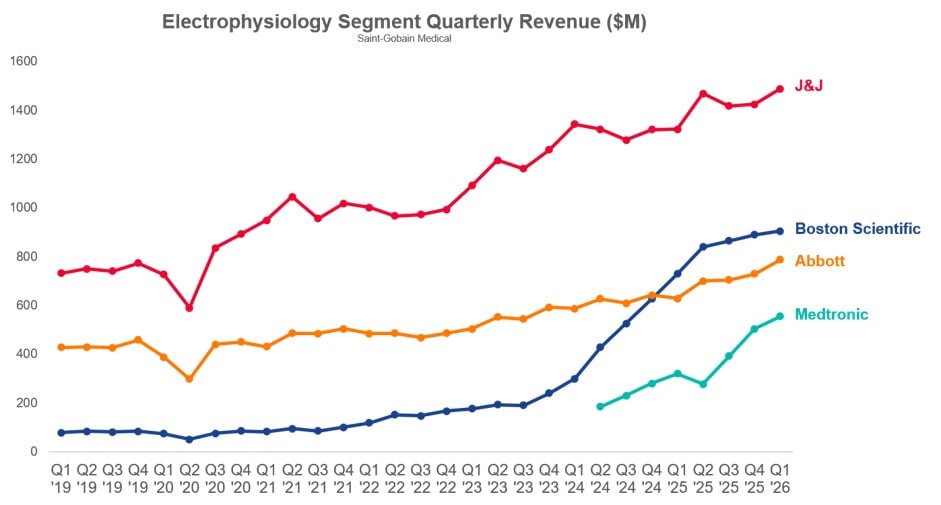
The year-end test is not whether every company can produce another favorable study or another physician quote. They will. The real test is whether EP labs begin standardizing around one or two PFA workflows. If Boston Scientific remains the default, the early lead was more than timing. If Medtronic or Abbott starts changing lab behavior, PFA will have done more than expand the ablation market. It will have re-ranked it.
Robotics is a Density Game, Not a Robot Game
Medtronic’s Hugo ™ U.S. launch is real. It is also easy to overread.
On February 17, Medtronic announced the first U.S. commercial case using its FDA-cleared Hugo robotic-assisted surgery system, a robotic-assisted prostatectomy performed at Cleveland Clinic. The early U.S. installation list included Cleveland Clinic, Duke University Hospital, and Atrium Health Wake Forest Baptist High Point Medical Center. After years of Hugo being an international robotics story, the system is now officially in the U.S. market.
That is a milestone. It is not yet a market.
Medtronic does not need Hugo to beat Intuitive Surgical’s da Vinci ® in 2026. That would be an absurd bar. Intuitive had 11,395 da Vinci systems installed worldwide as of March 31, 2026, including 6,477 in the United States. In Q1 alone, Intuitive placed 431 da Vinci systems, 232 of which were da Vinci 5 systems. Medtronic is trying to enter a market where the incumbent is still placing hundreds of systems per quarter.
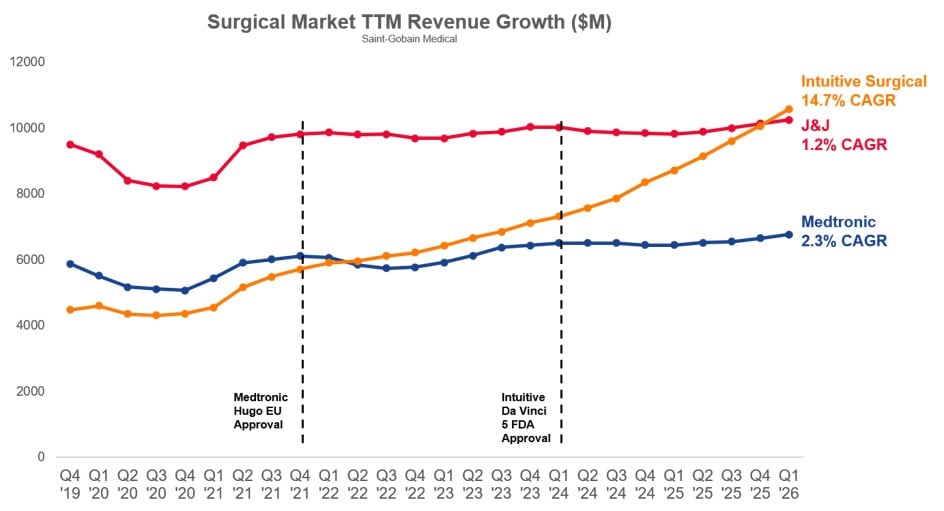
Intuitive’s lead is not just technical. It is gravitational.
That is why robotic surgery is such a hard challenger market. Technical credibility gets a company into the conversation. Density determines whether it stays there. Hospitals need trained surgeons, comfortable staff, reliable service, available instruments, efficient room turnover, predictable economics, and enough procedural breadth to keep a system meaningfully utilized. A hospital can install a second robot for strategic reasons. It only keeps booking cases on that robot if the workflow holds up when the cameras are gone.
The adoption funnel is longer than the announcement cycle makes it look. Clearance leads to installation. Installation leads to first case. First case has to become repeat use. Repeat use has to expand across surgeons and specialties. Only then does a challenger begin to create enough density for the platform to matter.
That is the Hugo question. Can Medtronic turn early placements into routine utilization beyond flagship urology centers? If the next six months are mostly first-case announcements, Hugo will still be a real U.S. launch, but not yet a scaled U.S. platform. If hospitals start using Hugo repeatedly across multiple sites and indications, the robotics story becomes much more serious.
A first case is not a market. In robotic surgery, density is the market.
M&A is Addition and Subtraction at the Same Time
The lazy read on 2026 is that medtech M&A is back. It is, but the more interesting pattern is that the largest companies are buying and cutting at the same time.
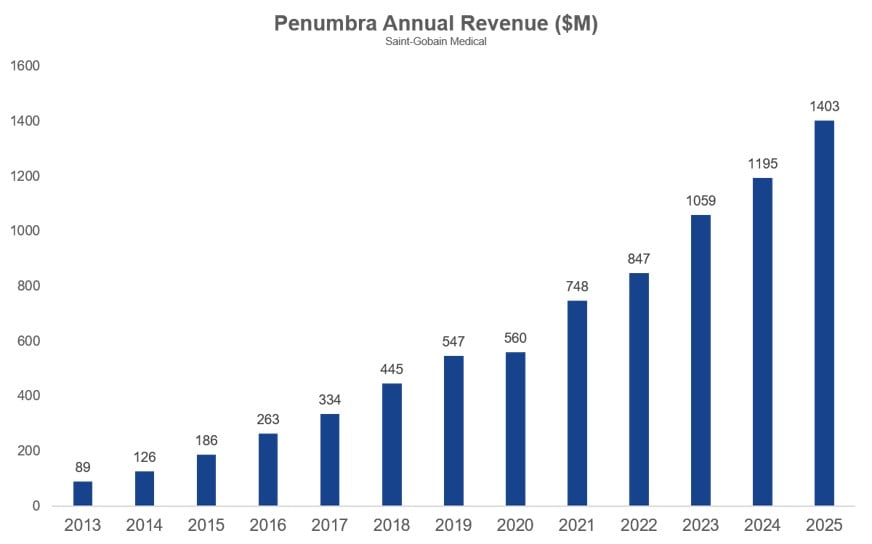
Some moves are expansional. Boston Scientific announced a $14.5 billion deal to acquire Penumbra, giving it a scaled entry into mechanical thrombectomy and neurovascular adjacencies. Abbott closed its $21 billion acquisition of Exact Sciences, deepening its position in cancer screening and diagnostics. Stryker acquired Amplitude Vascular Systems for up to $835 million, adding exposure to intravascular lithotripsy. Roche moved to acquire PathAI for up to $1.05 billion, pushing further into AI-enabled pathology.
Other moves are acts of subtraction. BD completed the combination of its Biosciences and Diagnostic Solutions business with Waters in a transaction valued at $18.8 billion at close. Medtronic has been separating MiniMed. Johnson & Johnson has been preparing to divest orthopedics.
The pattern matters. The largest medtech companies are not simply buying growth. They are deciding which markets deserve capital, management attention, commercial focus, and operating complexity.
The timing is not accidental. In markets where procedure platforms require dedicated sales effort, clinical evidence, training, service, and product iteration, broad portfolios become harder to defend. Investors want cleaner growth stories. Commercial teams want fewer priorities. R&D budgets need sharper allocation. Breadth only helps if it creates leverage. If it creates distraction, it becomes something to sell.
The deal logic is easy enough to understand. Penumbra strengthens Boston Scientific’s vascular and neurovascular position. Exact Sciences gives Abbott a deeper oncology diagnostics platform. Amplitude brings Stryker into IVL, a category already attracting major strategic attention. PathAI fits Roche’s push around diagnostics, pathology, and AI-enabled workflows. BD’s move narrows its business. Medtronic’s diabetes separation is a bet that focus can unlock a more coherent growth story.
The hard part starts after the press release. A transaction can look obvious in a banker’s deck and still create friction in the field. Customers need continuity. Sales teams need clarity. Manufacturing needs stable forecasts. Quality systems need alignment. R&D programs need to be kept moving. The acquired business has to retain the urgency, talent, and customer relationships that made it valuable in the first place.
That is where the 2026 M&A cycle will be judged. The best deals will not be the ones with the cleanest strategic rationale. They will be the ones where the platform keeps growing after integration begins.
Diabetes Tech: Growth Now, GLP-1 Anxiety Later
Diabetes technology is often described as a device market: CGMs and insulin pumps dominate the discussion. Yet that description is increasingly incomplete.
The market is becoming an automated care loop. CGMs generate continuous data. Delivery systems act on that data. Algorithms adjust therapies. Apps become the user interface. Coaching, payer coverage, prescribing behavior, and patient burden shape adoption. As those layers connect, diabetes technology starts to look less like a collection of devices and more like infrastructure for managing a chronic disease.
The shift matters most in Type 2 diabetes. The largest population is not the highly engaged Type 1 user who already lives inside diabetes technology. The harder and larger opportunity is reducing burden for people who need insulin support but may not want a highly interactive device experience. Better sensors and better pumps matter, but they do not solve the whole problem if the patient still must think about the disease constantly.
This is why Insulet’s EVOLVE pivotal study is worth watching. The study is designed to evaluate a fully closed-loop automated insulin delivery system for adults with Type 2 diabetes, with an algorithm that automatically adjusts insulin delivery and eliminates mealtime interaction. The strategic significance is not simply another clinical milestone. It is the attempt to move advanced insulin automation into a broader Type 2 population with less user burden.
That is the operating story. The market story is strange.
Insulet is reporting the kind of numbers most medtech companies would love to have. In Q1 2026, revenue grew nearly 34% to $761.7 million. Omnipod® revenue grew nearly 37%. U.S. Omnipod revenue grew more than 28%, international Omnipod revenue grew nearly 60%, and the company raised full-year guidance. Those are not the numbers of a business showing obvious evidence of GLP-1-driven revenue pressure today.
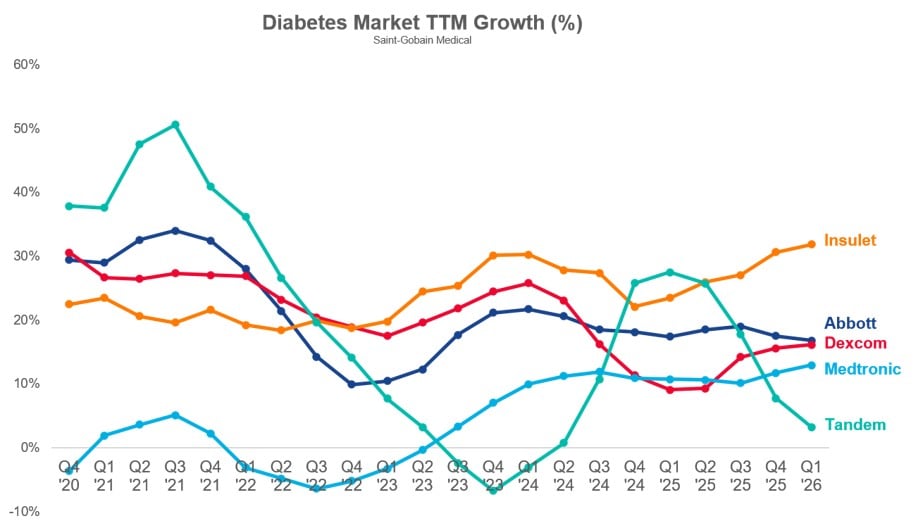
And yet the GLP-1 overhang remains.
This is one of the more interesting investor psychology stories in medtech. The fear is not necessarily that GLP-1s are crushing pump revenue right now. The fear is that they could change the future insulin funnel. If GLP-1s delay insulin dependency for some Type 2 patients, reduce disease progression, or shift treatment intensity, the long-term pool of pump-eligible patients could look different from what investors expected.
That is a real question. It is not the same thing as the current revenue weakness.
Right now, the evidence looks more like a mismatch between business performance and market anxiety. Insulet’s fundamentals are strong, but the stock can still get punished because investors are looking several steps ahead to a world where GLP-1s may alter the diabetes treatment pathway. The boogeyman is not imaginary, but it is not yet showing up the way the stock reaction sometimes implies.
That distinction matters. Diabetes tech companies are not simply defending against GLP-1s. They are expanding the market through automation, Type 2 indications, sensor integration, easier onboarding, and lower-burden therapy. In some scenarios, GLP-1s may reduce progression to insulin intensity for certain patients. In others, diabetes tech grows because the addressable population is still enormous; the installed base expands, and automation makes device therapy less intimidating.
Dexcom and Abbott are not just CGM companies. Insulet and Tandem are not just pump companies. Medtronic Diabetes is not just a legacy insulin delivery business preparing for separation. Beta Bionics is not just a challenger. Each company is deciding how much of the care loop it can own: sensing, delivery, algorithm, interface, prescribing pathway, patient experience, and payer logic.
Diabetes is not a procedure. It is a daily operating system for patients. The winner will not simply be the company that measures glucose or delivers insulin better. It will be the company that makes the disease easier to live with.
The year-end test is whether diabetes tech narratives stay trapped under the GLP-1 overhang or shift back toward evidence of market expansion. If companies like Insulet keep reporting strong growth while advancing lower-burden Type 2 automation, the market may have to separate what is happening now from what it fears could happen later.
Operating Resilience
Cybersecurity is now customer continuity
Stryker’s cyberattack belongs in this article, but not as a generic IT warning.
The important lesson is simpler and more uncomfortable: a product can be safe and still be unavailable when the company around it breaks.
Stryker said its March cyberattack affected order processing, manufacturing, and shipping, while also stating that its products remained safe to use. The disruption lasted long enough that, by late March, Stryker was still saying most manufacturing sites and critical lines had been restored; electronic ordering had returned, and the company was working through order processing and delivery. In May, CEO Kevin Lobo told investors the attack “meaningfully” affected first-quarter growth. Stryker reported Q1 sales of $6 billion, up 2.6% year over year, a sharp slowdown for a company that had been one of the steadier growers in medtech.
That is not primarily a product safety story. It is a customer continuity story.
For years, medtech cybersecurity has mostly been discussed through connected products: patient data, device vulnerabilities, remote monitoring, software patching, and hospital networks. Those issues still matter. But Stryker exposed a different failure mode. The business systems around the product can become bottlenecks.
If ordering slows, manufacturing is interrupted, and shipping is affected, hospitals do not experience that as an internal IT problem. They experience it as product uncertainty, manual workarounds, inventory pressure, and customer service friction. For many medtech categories, that matters because the product sits inside a time-sensitive clinical workflow. A delayed consumer product is inconvenient. A delayed surgical product, emergency care item, implant, instrument, or procedural supply can create real strain.
This makes cybersecurity part of operating resilience. A single-source supplier can stop product from reaching customers. So can a compromised digital environment. The factory may still be standing, but if the systems that take orders, schedule production, release product, coordinate logistics, and communicate with customers go down, customers feel it.
The market implication is bigger than Stryker. Medtech companies increasingly compete on reliability as much as innovation. Hospitals do not only need devices that work. They need companies that can support them, ship them, service them, and communicate clearly when something breaks. Cyber resilience is becoming part of that trust equation.
The year-end test should be more concrete than whether companies “talk more about cyber.” Watch whether cyber resilience starts appearing in the same places companies already discuss supply continuity and business continuity: earnings-call risk discussions, hospital procurement questions, supplier scorecards, and customer-facing continuity planning. If cyber stays in the IT appendix, the Stryker incident will be treated as an exception. If it moves into customer reliability conversations, the category will have shifted.
What We Will Know by Year-End
The rest of 2026 should tell us which of these stories are real shifts and which are just clean narratives.
- In PFA, the test is whether EP labs start standardizing around a default workflow, not whether companies can produce another round of favorable data.
- In robotics, the test is repeat utilization beyond flagship urology sites.
- In M&A, the test is whether acquired platforms keep their growth and field energy after integration begins.
- In diabetes, the test is whether the market can separate current growth from future GLP-1 anxiety.
- In cybersecurity, the test is whether cyber resilience moves from product security into customer continuity.
That is the mid-2026 scorecard.
The first half of the year made one thing clear: medtech markets are not simply moving toward better products; they are moving toward stronger systems. Some are procedure systems, like PFA and robotics. Some are portfolio systems, shaped by M&A and divestitures. Some are care systems, like diabetes technology, moving toward automation. And some are reliability systems, where communication, continuity, and trust matter as much as innovation.
The companies that win the rest of 2026 will not make complexity disappear. They will make it manageable enough that customers stop noticing it.
Want to stay up to date with the latest in medtech trends? Subscribe to Material Matters for quarterly insights delivered straight to your inbox.

What this means for medical device and component manufacturers


Robotic systems demand advanced tubing specs.
