




Demystifying IQ, OQ, PQ in Medical Molding
What Validation Really Mean on the Manufacturing Floor
Ever sat through a validation review and nodded along at "IQ, OQ, PQ," hoping no one asked you to explain them out loud?
You are not alone. These three acronyms are everywhere in regulated manufacturing, on checklists, audit reports, and customer documents. But unless you work in Quality or Engineering, they can sound more like compliance jargon than practical tools.
In molding environments that support medical device manufacturing, these stages are not just regulatory milestones. They are how we build confidence in our molds, our equipment, and our ability to make products that meet specifications not just once, but every day.
While the core definitions come from ISO 13485 and 21 CFR 820, how we apply IQ, OQ, and PQ in high-mix, process-intensive manufacturing settings is tailored to the realities of molding, extrusion, assembly, and device production. Let’s look at what they actually mean in practice.
Why Do We Validate in the First Place?
In medical manufacturing, it is not enough to say a process works. We are required to provide evidence it works with data and documentation.
Validation answers the question: Can this process, tool, or equipment consistently make conforming product under expected conditions?
It is a requirement. But more than that, it is how we protect our customers, our reputation, and the patients who rely on the products we help make.
Frequently Asked Questions: IQ, OQ, and PQ in Manufacturing Validation
Installation Qualification (IQ) confirms that equipment or tooling has been delivered, installed, and configured according to approved design specifications and regulatory requirements. It ensures the system is set up correctly before any process testing begins.
Operational Qualification (OQ) verifies that equipment or processes function as intended across their defined operating ranges. This stage involves testing under controlled conditions to establish a stable and repeatable process window.
Performance Qualification (PQ) demonstrates that the process can consistently produce acceptable results under routine production conditions. It confirms the system performs reliably with real operators, materials, and environmental variables in place.
IQ: Is the Setup Right?
Installation Qualification (IQ) confirms that equipment or tooling has been designed, installed, and configured properly.
That means:
- The right utilities and connections are in place
- Software versions, alarms, guarding, and sensors are verified
- Manuals, preventive maintenance schedules, and spare part lists are available and maintained
For molding validations, IQ also includes:
- Tool inspection and dimensional verification
- Mold heat mapping
- Gage R&R or Measurement system analysis for measurement systems to align with customer methods
IQ is a foundational step. We are not ready to test the process until we know the equipment or tooling is properly installed and able to be maintained over its lifecycle and the intended processes life cycle.
OQ: Can the Process Perform
Operational Qualification (OQ) is where functional testing truly begins. During this phase, we challenge the process at its extremes, high, low, and nominal settings, to confirm it can still produce acceptable product. This approach helps establish a robust processing window that ensures consistent performance.
Let’s say we have just installed a new mold. In OQ, we establish the clamp force, cycle time, barrel temperatures, and more process setting ranges. We check visual attributes and dimensional tolerances at each setting to ensure they meet product specifications. These OQs can evaluate a single mold dedicated to a single product in its simplest form, or an entire molding machine evaluating multiple molds within a product family in more complicated forms.
In most molding environments, OQ is a team effort:
- Engineering defines the window
- Production leads or Manufacturing technicians help run the parts
- Quality gathers capability data and guides inspection
Nothing from OQ is released to customers, but product can be tested for performance to ensure it can meet specifications. It is about defining a process window that gives us a wide enough range to handle raw material variations but is controlled enough to maintain a high level of quality.
PQ: Can it Run Day to Day?
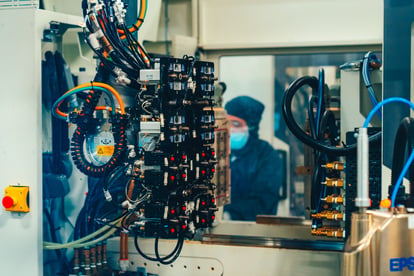
Performance Qualification (PQ) is the final check: can this process run reliably in day-to-day production?
We use the nominal process settings defined in OQ and introduce day to day variability:
- Different operators
- Multiple shifts
- Real batch sizes
- Raw Material lot variation
For injection molding, PQ involves longer runs (typical to batch size) using routine inspection plans. At this stage, all documentation and procedures have been finalized and are carried out by operators. The production run is formally documented in a PQ protocol, which must be successfully executed before product can be released.
Once PQ passes, the validated process is locked into the site’s Quality Management System.
Are IQ, OQ, and PQ Always the Same?
It depends. Different companies define IQ, OQ, and PQ slightly differently. Some combine phases. Others use additional steps like factory acceptance test (FAT) or site acceptance test (SAT). What matters is consistency and clarity when we explain our approach to customers or auditors.
At Saint-Gobain, all validation protocols, whether IQ, OQ, or PQ, follow a consistent approach. Each protocol must be formally approved before execution to ensure alignment with predefined specifications and detailed instructions outlined in the document. Additionally, any sampling plan included in these protocols must be supported by a robust statistical rationale. In molding operations, definitions are grounded in standards but applied practically. If a mold is modified, a gage updated, or a machine relocated, teams assess through change control what needs to be revalidated based on risk and the scope of the change.
Why Validation Matters to Everyone
Even if you are not writing validation protocols, IQ, OQ, and PQ affect your work:
- Operators need to know when they are running validated processes and when something changes.
- Production leads need to plan resources around validation runs.
- Tech services need to trust that what we validate will perform at the customer site.
- Quality needs to ensure that every output stands up to audit.
Validation is a team effort. By confirming that equipment, systems, and processes perform as intended, validation reduces risk, prevents costly errors, and ultimately ensures that the end user receives a reliable and safe product. In short, validation is everyone’s responsibility because quality impacts us all.
From Acronyms to Assurance
Validation is not about paperwork. It is about knowing that a process is capable, controlled, and ready for production. So next time someone says, “We are in OQ,” you will know: the team is limit-testing the process so that when it goes live, it does so with confidence.


Explore why ISO standards alone aren’t enough for true contamination control


What manufacturers need to know about medical-grade standards