




Why Injection Molding Still Leads Over 3D Printing
Injection Molding vs. 3D Printing for Silicone Components
Silicone is an essential material in medical devices, commonly used in seals, valves, wearable interfaces, and overmolded assemblies. As additive manufacturing continues to evolve, many device developers are asking whether 3D printing can replace traditional injection molding for silicone parts. While 3D printing has its place during early development, it is not yet a viable option for producing regulatory-grade silicone components at scale.
This article breaks down when each method makes sense and explains why injection molding remains the preferred approach for medical devices.
Choosing the Right Method for the Job
Development Need | Recommended Approach | Why |
|---|---|---|
High-volume production requiring validated materials | Injection molding | Consistent quality, proven biocompatibility, and tight tolerances |
Early design iteration or fit testing | 3D printing | Rapid prototyping without the cost or lead time of tooling |
Bridge production before final tool release | Soft tooling or printed mold inserts | Matches production properties and reduces transition risk |
Complex prototype geometries | 3D printing | Allows freedom in shape exploration without immediate mold investment |
Injection Molding: Reliable, Scalable, and Proven
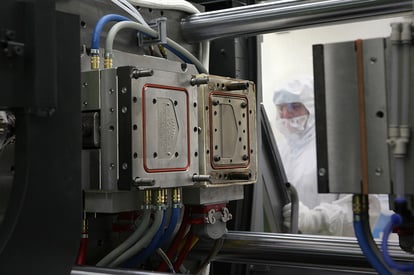
Liquid injection molding (LIM) has been the backbone of silicone manufacturing in medical devices for decades. It supports everything from single-lumen septa to complex overmolded assemblies. With access to medical-grade LSR materials and robust process control, LIM delivers repeatable results across large volumes.
Advantages:
- Established regulatory track record. Most LIM materials have long histories of ISO 10993 and USP Class VI certification.
- Excellent mechanical performance. Molded parts offer high tear strength, elasticity, and stability over time.
- Predictable, scalable output. Once the mold is dialed in, LIM produces consistent parts across tens of thousands or millions of units.
- Process control. Molded parts benefit from closed-loop feedback systems and statistical process monitoring, which is essential for regulatory manufacturing.
3D Printing: A Design Tool, Not a Manufacturing Process
3D printing of silicone has improved over the past few years, with newer systems capable of printing true platinum-cured elastomers. These parts are useful during early prototyping, especially when exploring new geometries or confirming fit within an assembly.
That said, there are important limitations that make printed silicone parts unsuitable for most production applications.
Drawbacks:
- Surface finish and dimensional accuracy vary. Most printed silicone parts require post-processing, and surface consistency is often not reliable enough for sealing features or optical clarity.
- Mechanical properties fall short. Printed parts often have lower tear strength, reduced elasticity, and anisotropic properties due to the layer-by-layer process.
- Regulatory uncertainty. Few printed silicones have the extensive biocompatibility data needed for FDA or CE submission. Material reproducibility can also be an issue.
- Process mismatch. Even if the geometry is similar, printed and molded silicone behave differently. A design that functions when printed might fail once molded due to differences in compression, rebound, or sealing dynamics.
For these reasons, 3D printing is best viewed as a fast way to explore form and assembly fit, not function under production conditions.
A Better Way to Bridge: Printed Molds and Soft Tooling
If speed is a priority but production intent is still the goal, consider using bridge tooling or 3D-printed molds. These approaches allow for faster part iteration while using the same materials and process principles as final injection molding.
Printed molds or low-volume aluminum tools can produce small quantities of molded parts that behave like production units. This reduces surprises during scale-up and gives your team a clearer path to validation and regulatory submission.
Choosing the Best Molding Solution for Long Term Success
3D printing is a helpful tool for exploring new designs, but it is not ready to replace injection molding for medical-grade silicone components. For programs that require consistent performance, tight tolerances, and validated materials, LIM remains the most reliable option.
If you're looking to speed up development without sacrificing long-term manufacturability, bridge tooling strategies such as 3D-printed molds or soft tools offer a better solution. These options allow you to prototype quickly while staying aligned with production requirements, helping avoid costly delays or revalidation down the line. Contact us today to discuss your medical molding needs.


Scaling up the injection molding of medical device components


Engineering smarter systems from the inside out
