Ensuring Accurate IV Fluid Administration
Understanding infusion pump performance
Intravenous (IV) fluid therapy is a critical component of patient care, but its administration can be difficult and even dangerous. In hospitals, one in five patients treated with IV fluid therapy experiences complications due to inappropriate administration. Errors in the preparation and administration of IV medications have been reported in 13–84% of cases.1,2 IV infusion is associated with approximately 60% of adverse drug events in healthcare settings3, highlighting the importance of precise rate administration for patient safety.
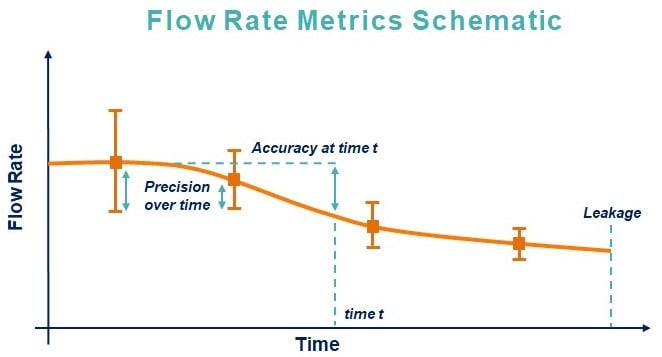
One way to improve patient outcomes and safety is to understand and control the variability in flow rates of infusion devices. Take perioperative care, for example - excessive intraoperative fluid volume can cause edema or organ dysfunction, while inadequate fluid volume can lead to hypoperfusion and organ ischemia. Therefore, understanding and controlling the variability in flow rates of infusion devices is crucial for improving patient outcomes and safety.4
Volumetric pumps in healthcare
Volumetric pumps are the most commonly used type of infusion pump in healthcare settings, and for good reason. They use linear or rotary peristaltic pumping mechanisms to deliver fluid through flexible tubing fitted inside the pump casing. As the pump's motor turns, “fingers” or “rollers” squeeze and release the tubing, pushing fluid toward the patient in evenly spaced boluses and preventing backflow. The flow rate is controlled by adjusting the frequency of motor rotations, typically achieving an accuracy of ±2.5 - 6%. These pumps are ideal for both hospital and ambulatory settings where portability, safety, and high flow accuracy are required.5-7
Factors affecting pump performance
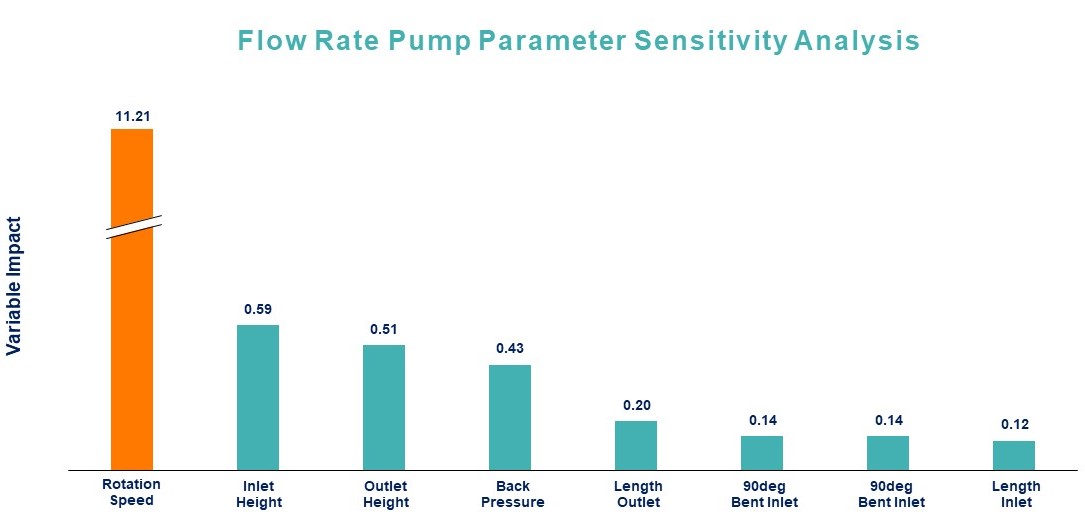
How do we ensure that the flow rate accuracy is as precise as possible? Well, we need to understand the primary variables influencing pump performance. These include the pump's layout (such as flow meter location, inlet and outlet reservoir heights, and tubing bends) and operational conditions (such as rotational speed and fluid viscosity). We conducted an extensive Design of Experiments (DOE) in a controlled environment, equipped with flowmeters and pressure sensors, to analyze and isolate how the pump’s layout parameters affect flow rate, pressure, and power draw. Through a one-at-a-time (OAT) sensitivity analysis, we were able to measure the impact of the parameters of interest on the pump performance and rank them by importance. The impact of each parameter is measured as the percentage variation of the output as a function of the percentage variation of the given parameter, that can be written as follows:
% Variation of the Output Variable / % Variation of a parameter x=|%Δy(x)/%Δx|,
where the percentage variation of the output is computed as %Δy(x)=(y(x0+Δx)−y(x0))/(V(x0)) and the percentage variation of the input is computed as %Δx=Δx/x0. The variations of all the parameters are computed from the same reference configuration represented by x0, but the variation of each parameter depends on the parameter itself Δx=x−x0. The sensitivity analysis data is shown below in Figure 2.
Key findings from sensitivity analysis
The sensitivity analysis revealed that pump rotational speed has the largest effect on flow rate, which may not come as a surprise. However, we also found that other variables, such as back pressure and the heights of the inlet and outlet, also significantly influence flow rate. Many clinicians are unaware of these factors, leading to potential inaccuracies in infusion delivery of up to +/- 30%.8
By understanding these factors, we can work together to ensure accurate and safe IV fluid administration for all patients.
Component-level influences: focus on tubing
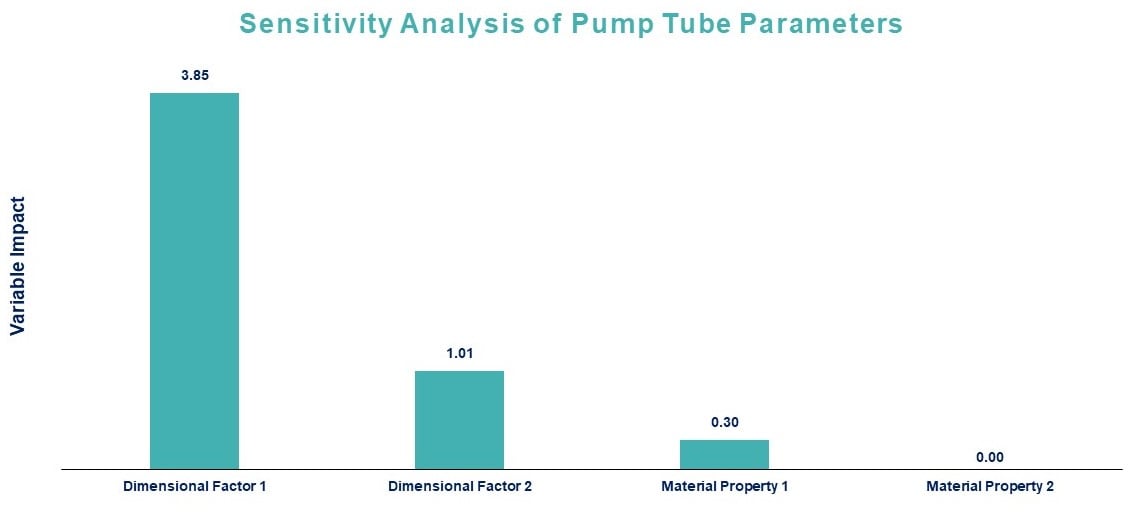
We've talked about how pump design and operational conditions can impact flow rate accuracy, but did you know that tubing characteristics also play a role? That's right - beyond design and configuration, the type of tubing used can impact flow rate accuracy. Research shows that materials like silicone maintain consistent performance over time, while materials like PVC can degrade and reduce their ability to rebound, ultimately impacting the average flow.
Using computational simulation and experimental results, we have ranked the parameters that affect flow rate accuracy within an infusion pump. For proprietary reasons, specific variables will remain confidential, but Figure 3 highlights the significant impact of certain tube-related variables.
Here to help
We understand that navigating the multitude of factors that impact infusion pump performance and flow rate accuracy can be overwhelming. That's where we come in. With decades of experience in supporting the drug delivery market, we have a deep understanding of how these variables affect pump outputs such as flow rate, pressure, and power draw. Our expertise enables us to guide you through these decisions and provide optimal tubing recommendations to maximize infusion pump performance, helping to ensure safe and effective patient care.


Citations
- Taxis K, Barber N. Ethnographic study of incidence and severity of intravenous drug errors. BMJ 2003;326:684–687.
- Keers RN, Williams SD, Cooke J, et al. Causes of medication administration errors in hospitals: a systematic review of quantitative and qualitative evidence. Drug Saf 2013;36:1045–1067.
- Giuliano KK. IV smart pumps: the impact of a simplified user interface on clinical use. Biomed Instrum Technol 2015;suppl:13–21.
- Ko E, Song YJ, Choe K, et al. The effects of intravenous fluid viscosity on the accuracy of intravenous infusion flow regulators. J Korean Med Sci 2022;37:e71.
- Moog Medical. (2020, February). CURLIN: Infusion technology and its benefits.
- Klespitz J, Kovacs L. Peristaltic pumps – a review on working and control possibilities. IEEE International Symposium on Applied Machine Intelligence and Informatics, Herl’any, Slovakia, January 23-25, 2014:191–194.
- Poxon I. Infusion pumps – How to pick the best pump for the delivery of fluids. Nursing Times, July 1, 2004.
- Van de Castle B. Infusion pump performance: Flow accuracy and continuity often don’t add up. Patient Safety & Quality Healthcare, August 10, 2011.

Six Key Parameters for Tubing Selection


What it is and why it matters