


- Why ABS is More than a “Housing Plastic”
- What ABS Really Is: A Rubber‑Toughened SAN System
- SAN-Rich Matrix: Hard Surface, Stiffness, and Product Feel
- What “Tough” Means in ABS (and What It Doesn’t)
- Why ABS Shows Up in Medical Housings: Surface Quality and “Product Feel”

Why ABS is More than a “Housing Plastic”
Acrylonitrile Butadiene Styrene (ABS) is one of the most familiar plastics in product design, and that familiarity often hides how instructive the material really is. It is easy to talk about ABS as if it were simply a good housing resin: easy to mold, visually clean, reasonably tough, widely available. All of that is true. None of it gets to the heart of the material.
The reason ABS matters is more interesting. ABS works because it hides a rubber toughening system behind a hard, glassy styrenic surface. On the outside, ABS looks and feels like a rigid product plastic. Inside, it is a deliberately engineered multiphase system built to make a brittle-leaning styrenic matrix much more damage tolerant than it would be on its own.
That is why ABS has been so successful in medical housings, bezels, covers, handles, and other visible device architecture. Many external medical parts do not need the most advanced chemical resistance or the highest thermal ceiling. They need something more specific. They need to look clean, hold geometry, reproduce texture well, survive assembly, tolerate handling, and communicate product solidity. Rigid styrenics offer good appearance but are easily damaged; softer resins withstand abuse but lack the desired finish. ABS sits in the middle because its morphology was built for exactly that compromise.
So, the right way to understand ABS is not as “housing plastic.” The better question is how a rigid SAN-type matrix and a butadiene rubber phase work together, how that structure is frozen into a molded medical part, and how that part behaves once bosses, weld lines, snaps, cleaners, sterilization, and time all enter the picture. That is where ABS becomes much more than familiar. That is where it becomes good material science.
The family’s value does not come from three ingredients sitting side by side. It comes from heterogeneous structure. The morphology, not just the composition, is the real answer."
What ABS Really Is: A Rubber‑Toughened SAN System
The name acrylonitrile butadiene styrene sounds as though the material should be understood by adding three monomer contributions together. At a beginner level, that is serviceable. At an engineering level, it is too simple.
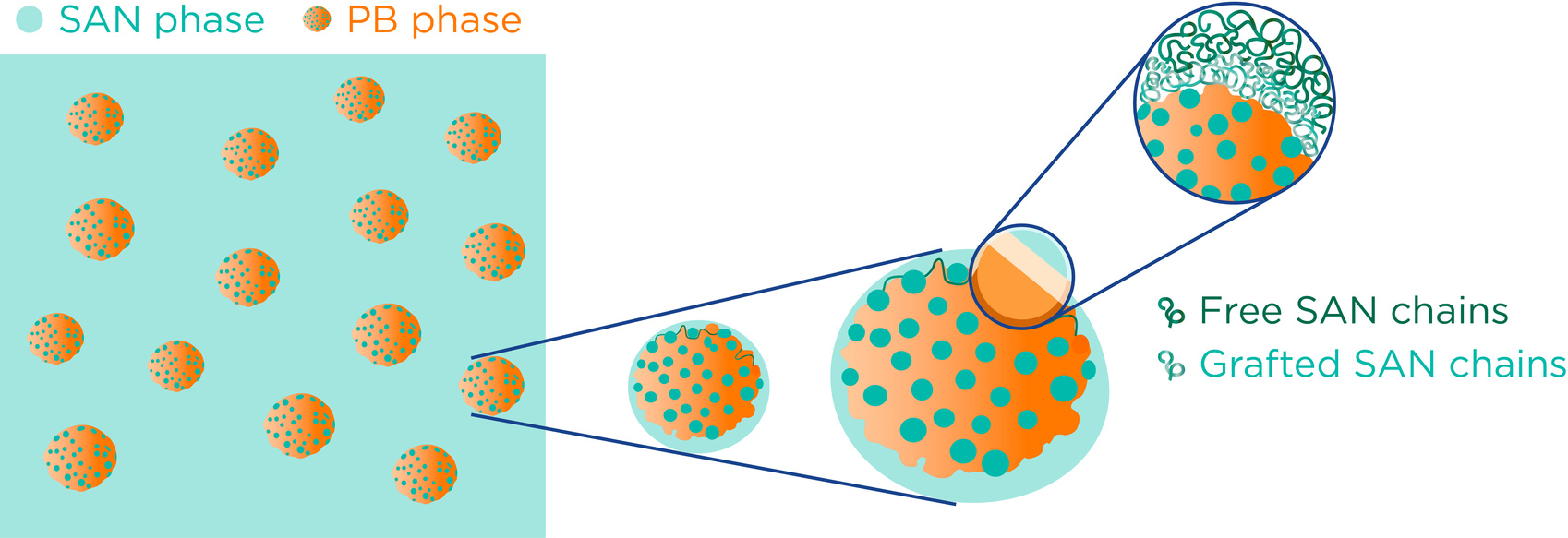
ABS is better understood as a rubber-toughened glassy polymer system. In most commercial ABS materials, the continuous phase is a styrene-acrylonitrile-rich matrix, often described in SAN terms. That matrix provides the hard surface, much of the stiffness, much of the dimensional feel, and the surface quality that makes ABS so attractive in visible parts. Embedded within that matrix is a polybutadiene-rich rubber phase. That phase is not there to make the material soft in the ordinary sense. It is there to change the failure mechanics.
This is the first major lesson about ABS. The family’s value does not come from three ingredients sitting side by side. It comes from heterogeneous structure. The morphology, not just the composition, is the real answer.
That is also why grade-to-grade behavior can move more than the casual user expects. Rubber content matters. Rubber particle size matters. The degree of grafting or interfacial connection between the rubber and matrix matters. Matrix composition and molecular weight matter. Additives and flow behavior matter. Two materials can both be called ABS and still differ meaningfully in impact response, gloss, processability, crack resistance, and stress sensitivity because they are not just “the same chemistry with minor tweaks.” They are different morphological systems.
This point is central if the goal is to teach ABS rather than merely describe it. The material family is a lesson in how a polymer system can be engineered around phase behavior to deliver a very specific product outcome.
SAN-Rich Matrix: Hard Surface, Stiffness, and Product Feel
The rigid phase in ABS deserves more attention than it usually gets, because it is what gives the family its external identity.
The styrene portion of the matrix contributes to flow, moldability, and the familiar hard-surfaced character of styrenic plastics. Styrene-rich systems tend to mold into visually clean parts with good replication of surface detail and a controlled, product-like feel. Acrylonitrile changes that matrix in important ways. It makes the matrix more chemically serious than plain polystyrene, raises stiffness, and contributes to the harder, more structured response that distinguishes ABS from simpler styrenics.
That is why ABS does not feel like a commodity olefin in the hand. The matrix is glassy, structured, and visually disciplined. In medical housings, that matters. A bench-top analyzer cover, handheld diagnostic shell, or interface bezel often needs more than just nominal strength. It needs surface authority. It needs to feel exact. It needs to look intentional. The SAN-rich matrix is what gives ABS that product feel.
This also helps explain why ABS occupies a different design space than polypropylene. Polypropylene can be very useful, but it usually feels softer, waxier, and less crisp as visible product architecture. ABS feels more finished because its matrix is fundamentally different. It is not just stiffer. It is more glassy, more surface-defined, and more willing to carry the cosmetic burden of a visible part.
But this is only half the story. The same matrix, if left on its own, would not make ABS the material it is. A glassy styrenic matrix can look excellent and still fail too abruptly in the real world. That is why the rubber phase matters so much.
The butadiene rubber phase: the hidden toughening mechanism
This is the center of the whole material family.
ABS is not tough because it is generally softer. It is tough because the butadiene phase changes how stress localizes and how cracks initiate and grow through the material.
A glassy SAN-type matrix on its own is structurally useful but comparatively notch-sensitive and less forgiving under impact. When a local flaw, weld line, corner, or sharp feature concentrates stress, the matrix can respond in a brittle-leaning way. The dispersed butadiene rubber phase changes that. Under load, the rubber domains can deform, cavitate, or debond in ways that redistribute the local stress field. That redistribution promotes broader plastic deformation in the matrix, often through shear yielding, rather than letting the crack run in a more abrupt way.
Why morphology drives grade‑to‑grade differences
That mechanism is the whole reason ABS behaves the way it does in housings. The part still feels hard because the continuous phase is still glassy and rigid. But when something goes wrong, an impact, a dropped part, a local overstress at a snap, a hit at a bezel corner, the internal morphology gives the material a second mode of response. Instead of acting like a neat rigid styrenic, it can dissipate energy more gradually.
This is a classic lesson in rubber toughening of glassy polymers. ABS deserves to be taught that way. It is one of the most commercially important examples of how a dispersed rubber phase can transform the practical toughness of a rigid matrix without turning the material into a visibly soft plastic.
That is also why rubber morphology matters so much. Toughening efficiency depends on more than rubber content. Domain size, spacing, dispersion quality, and interfacial behavior all shape how well the matrix can be induced to yield rather than crack. A high-impact ABS and an appearance-focused ABS may both belong to the same family while delivering very different tradeoffs because the underlying toughening system is not tuned the same way.
What “Tough” Means in ABS (and What It Doesn’t)
Damage Tolerance without a Soft Feel
ABS is not a soft, elastomeric, or forgiving-feeling material in the way TPEs or TPVs are. It remains a hard-surfaced, glassy thermoplastic. Its usefulness comes from damage tolerance, not deep compliance.
That is why it fits so naturally in product shells and external device parts. A medical housing usually does not want to feel rubbery. It wants to feel hard, deliberate, and stable. The device should seem finished, not squishy. ABS gives product teams that hard surface and crisp visual language while quietly carrying a tougher failure mechanism inside.
That is also why ABS can be misunderstood in both directions. Some people underestimate it because it looks cosmetic. Others overestimate it because they hear “tough” and assume that means chemically robust, heat tolerant, and broadly forgiving in every environment. Neither is right. ABS is tough in a specific way. It is tougher against impact and brittle fracture than its surface suggests. That does not mean it is indifferent to disinfectants, radiation, thermal stress, or long-term chemical exposure under load.
A good mental model is that ABS gives a housing the appearance of a rigid styrenic and the survival instincts of a tougher one. That is a much more accurate way to think about the family.
Why ABS Shows Up in Medical Housings: Surface Quality and “Product Feel”
One reason ABS remains so persistent in medical housings is that it tends to produce parts that already look like finished products. That is not styling trivia. For visible medical components, it is part of the engineering equation.
The SAN-rich matrix supports good surface finish, good texture reproduction, controllable gloss, and a molded appearance that often feels “resolved” without exotic finishing steps. That makes ABS attractive in user-facing enclosures, control surfaces, analyzer covers, and other external components where the material is doing visual work as well as mechanical work.
This matters because medical products are judged visually long before they are judged through a materials database. The enclosure is the product for many users. If a part looks cheap, drags badly in texture, shows inconsistent gloss, or feels insubstantial, that is a product problem even if the tensile properties look acceptable.
ABS often succeeds because it combines good cosmetic molding with enough rubber toughening that the housing does not become cosmetically refined but mechanically fragile. It is one of the clearest examples of a material whose product value comes from both morphology and surface behavior together.
That also means the way ABS ages visually matters. Cleaner-induced dulling, mar, whitening around stressed features, or microcracking may all matter to the device long before a structural break occurs. For medical housings, appearance retention is not vanity. It is part of how the material performs its job.
Key Risk: Environmental Stress Cracking (ESC)
If there is one boundary that should always be taken seriously when ABS is used in medical devices, it is this one.
ABS can perform beautifully in dry handling, ordinary impact testing, and benign indoor use, then become much less forgiving when local stress and cleaning chemistry act together. That is the real logic of many ABS failures in medical housings.
The reason is not mysterious. The SAN-rich matrix can carry local stress effectively, but that same local stress around bosses, screws, snaps, sharp corners, and molded-in constraints also creates vulnerability. Once an incompatible cleaner or solvent enters that stressed region, the material may craze, whiten, microcrack, or eventually crack more fully. The rubber phase that helps in impact does not erase that risk. It belongs to a different failure story.
This is why ABS has to be judged through the combination of stress plus chemistry plus time. A wipe-down environment that seems ordinary at the family level may still be damaging at the part level if the geometry contains trapped stress or highly loaded features. A housing may look perfectly stable for months and then begin to fail first at the assembled snap, the boss root, or the corner that carries the most internal stress.
That is one of the most important medtech lessons about ABS. It is often more impact tolerant than people expect and more chemically conditional under stress than people expect. Both are true because the material’s morphology is optimized for one type of damage problem, not every type.
Durability over time: butadiene toughening helps early and can complicate aging
The butadiene phase is what makes ABS such a good product material. It is also part of why the family has real aging limits.
Polybutadiene contains unsaturation, and unsaturation means chemically more active sites than a fully saturated backbone would provide. Under oxygen, heat, light, and time, those sites are more vulnerable to oxidative change. That matters because the rubber domains are not decorative. They are the toughening mechanism. If oxidation changes those domains, their ability to absorb energy and blunt brittle behavior can change with them.
This is one reason long-term environmental durability and impact retention need honest evaluation in tougher service conditions. A fresh ABS housing may survive drops or assembly abuse well because the rubber phase is doing its job. A more aged part may not respond identically if oxidation, thermal history, or cleaner exposure has altered that phase.
In medical devices, the implication is usually not outdoor weathering in the classic consumer-products sense. It is indoor aging under repeated wipe-downs, sustained product life, and moderate thermal exposure. But the principle is the same. The chemistry of butadiene is part of the family’s value and part of its boundary.
This is also why neighboring materials such as ASA or blends such as PC/ABS exist as meaningful alternatives. Not because ABS is a weak material, but because the specific butadiene-based toughening route comes with a particular aging profile that may or may not fit the product.

How ABS Compares to Nearby Choices (HIPS, PP, PC/ABS, ASA)
A useful ABS article should also help the reader place it among nearby choices.
Compared with HIPS, ABS generally brings a more chemically serious and more engineered matrix through the acrylonitrile-containing phase, which helps explain why it is often the more capable housing choice. Compared with polypropylene, ABS usually offers a harder surface, better visual discipline, and a more finished product feel, though not the same level of chemical indifference that some polyolefin systems can provide. Compared with PC/ABS, ABS is often the simpler and more economical answer when the extra heat resistance and higher-end toughness of the blend are not actually needed. Compared with ASA, ABS often remains the familiar indoor housing choice, while ASA becomes more attractive when weathering and UV durability matter more.
These comparisons matter because they sharpen what ABS actually is. It is not the toughest resin in the room. It is not the most chemically robust. It is not the most heat resistant. It is a very good answer when a product needs a hard-surfaced, good-looking, dimensionally controlled housing material with a built-in toughening mechanism behind it.
That is a narrower statement than “good housing plastic,” and much more useful.
Heat Resistance: Practical, Not Heroic
ABS often feels solid enough that teams casually overestimate its thermal comfort zone.
The family performs well in many ordinary indoor device conditions. For room-temperature enclosures, benchtop architecture, handheld products, and external components that are not exposed to repeated severe heat, ABS is often entirely appropriate. But the material is not built around extreme thermal robustness. As temperature rises, modulus falls, creep becomes more relevant, residual stress becomes more likely to reveal itself, and the combined effects of heat plus cleaners or load become more serious.
In visible parts, that may first show up as local deformation, snap-force loss, distortion around interfaces, or gloss and appearance shifts rather than dramatic collapse. That is important because product teams often confuse “looks serious” with “holds shape under everything the product might see.” Those are not the same.
ABS is therefore strongest in disciplined everyday temperature ranges, not in architectures that lean heavily on thermal extremes or repeated heat-heavy sterilization.
Sterilization Tells You Whether ABS Is in the Right Role
Sterilization is often one of the cleanest ways to see whether ABS is being used naturally or being over asked.
Ethylene oxide is usually the least disruptive route for ABS-containing external parts because it avoids the harshest thermal loading and does not directly impose ionizing damage. Even then, the real questions are part-level. Does the housing keep its fit? Does the appearance remain acceptable? Does the stress state stay quiet through process and aging?
Gamma and e-beam deserve more caution. Ionizing radiation can alter color, odor, and longer-term mechanical behavior, particularly in a rubber-modified morphology where oxidative chemistry and phase changes matter. A visible housing may still be “intact” after radiation exposure and yet no longer be the same housing material from an appearance or durability standpoint.
Steam and repeated heat-moisture sterilization are usually where ABS feels least natural. The family is simply not built for that kind of repeated severity. The part may not need to melt to become a poor answer. It may soften, distort, discolor, relax, or lose too much of its original product confidence to remain appropriate. That is why ABS is usually much more at home in external device architecture than in components expected to live a sterilization-heavy life.
That is not a flaw. It is a boundary. The family was optimized around visible molded parts, not around repeated aggressive sterilization.
Processing History Becomes Part of the Material
ABS is one of those materials where molded-part reality matters just as much as resin choice.
A generic data sheet can tell you impact strength, flexural modulus, heat deflection temperature, and gloss potential. Useful. Not enough. Real ABS housings fail or succeed in weld lines, boss roots, snap details, sharp corners, ribs, textured surfaces, and packed versus poorly packed regions. That is where morphology meets part design.
Weld lines can become both cosmetic and mechanical weak points. Cooling history can lock stress into the part. Local orientation and packing can affect not just dimensional performance but gloss, texture response, and whitening behavior. A boss that looks perfectly molded may still carry enough internal stress to become the first point of chemically assisted cracking months later. A bezel corner that looks cosmetically perfect may still be the weakest impact feature on the whole enclosure.
This is why ABS evaluation has to happen in real geometry early. Cleaner exposure should be tested on assembled parts, not just plaques. Snap behavior should be evaluated in molded features, not just inferred from modulus. Gloss, texture, and mar resistance should be looked at in actual product surfaces, not just in abstract finish language.
With ABS, the molded housing is the real material.
Choosing the Right ABS Grade
Morphology, Flow, and Exposure
One of the most common mistakes in ABS selection is assuming the family name carries more precision than it does.
In reality, grade choice matters because the balance between matrix rigidity, rubber toughening, flow, appearance, and environmental comfort can shift significantly. Rubber content affects impact behavior, stiffness, and surface feel. Matrix characteristics affect gloss, hardness, and dimensional quality. High-flow grades may mold beautifully into complex geometry and still behave differently in tougher service than higher-impact grades. Additives can change oxidation behavior, color, process stability, and more.
That means the correct ABS grade is never just the one that fills the tool. It is the one whose morphology and exposure profile fit the actual part.
In medical devices, that also means the right grade is the one whose documentation, change control, and use-environment fit the actual program. A housing resin is not successful because it produced a good-looking T1. It is successful because it still looks and behaves appropriately after assembly, cleaning, aging, and whatever sterilization or exposure history the device imposes.
How to Evaluate ABS Correctly in Medical Devices (A Practical Framework)
ABS is valuable because it pairs a rigid, hard-surfacing SAN-type matrix with a butadiene-based toughening system that makes visible molded parts much more resilient than they appear. That is the central idea to keep.
- Start with morphology: identify whether the grade is optimized for appearance, impact, or flow and what that implies about rubber content and domain structure.
- Validate ESC at the part level: test real bosses/snaps/weld lines under realistic stress and cleaner combinations over time.
- Check appearance retention: texture/gloss stability, whitening, mar, and cleaner-induced dulling on actual molded surfaces.
- Interrogate process history: look for weld-line weakness, residual stress, and packing/orientation effects in the geometry you will ship.
- Match sterilization and temperature exposure: confirm the chosen sterilization route and thermal history won’t undermine fit, cosmetics, or long-term toughness.
The SAN-rich matrix gives ABS its stiffness, its product feel, its dimensional sharpness, and its cosmetic strength. The butadiene phase gives it a tougher failure mode by changing how local damage develops. Together, those phases create one of the most useful housing materials in product design.
That same morphology also defines the family’s limits. The material is not broadly indifferent to harsh cleaners, stressed chemical exposure, repeated severe sterilization, or long-term oxidative aging. It is not meant to be. ABS is most natural when the part needs to look finished, feel rigid, and survive ordinary product life, not when it is being pushed into an extreme-environment role.
So, the right engineering question is never simply whether ABS has a good impact number or a nice molded surface. The right question is whether this exact balance between SAN matrix behavior, butadiene toughening, molded-in stress, and environmental exposure fits what the real medical part will experience over time.
That is how ABS should be understood. And when it is understood that way, it becomes much easier to use well. In the right medical application, ABS is not just a common housing material. It is a very practical and very instructive example of rubber toughening turning a glassy styrenic into a much more capable product polymer.

PC’s impact, chemical, and sterilization resilience explained


Why thermoplastic choice drives molding success